


Page 433 - The Book of Caterpillars: A Life-Size Guide to Six Hundred Species From Around the World
P. 433
MOTH CATERPILLARS

                      FAMILY  Saturniidae
                  DISTRIBUTION  Guiano-Amazonia (northern South America, south and
                           east of the Andes)
                     HABITAT  Tropical forests and savannahs
                  HOST PLANTS  Trees of the Bombacaceae family
                      NOTE  Caterpillar that has two long, straight “horns” at immature stages
             CONSERVATION STATUS  Not evaluated


                                                                                   ADULT WINGSPAN
                                                                                 4 ⁄  –6 ⁄   in (107–153 mm)
                                                                                  CATERPILLAR LENGTH
                                                                                    3¾ in (95 mm)
            TITAEA LEMOULTI
            TITAEA LEMOULTI                                                                      431

            (SCHAUS, 1905)


            The Titaea lemoulti caterpillar, when it hatches from its white
            egg, is banded black and white, with orange head, legs, and tail.
            It has two long, fork-tipped tubercles behind its head and an
            erect one on the last segment. All subsequent instars, except the

             fth (last) instar, possess two very long “horns” on the dorsum
            behind the head. In order to avoid detection by birds or other
            predators, the mature caterpillar is colored in a pattern to
            somewhat resemble the V shapes formed by the leaves of its host
            plant, such as Bombacopsis species.


            The fully grown caterpillar burrows deep into the ground to
            pupate, as do other members of its subfamily, the Arsenurinae.

            There are  ve species of Titaea occurring from lowland southern
            Mexico south to Bolivia and southern Brazil. The adults of most
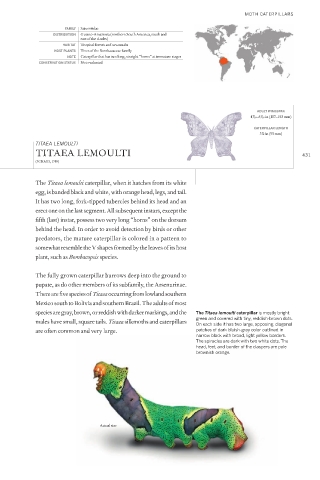
            species are gray, brown, or reddish with darker markings, and the   The Titaea lemoulti caterpillar is mostly bright
            males have small, square tails. Titaea silkmoths and caterpillars   green and covered with tiny, reddish-brown dots.
                                                                On each side it has two large, opposing, diagonal
            are often common and very large.                    patches of dark bluish-gray color outlined in
                                                                narrow black with broad, light yellow borders.
                                                                The spiracles are dark with two white dots. The
                                                                head, feet, and border of the claspers are pale
                                                                brownish orange.


                                 Actual size

