


Page 432 - The Book of Caterpillars: A Life-Size Guide to Six Hundred Species From Around the World
P. 432
MOTH CATERPILLARS

                                                     FAMILY  Saturniidae
                                                 DISTRIBUTION  North America
                                                    HABITAT  Woodlands

                                                  HOST PLANTS  Honey Locust (Gleditsia triacanthos) and Kentucky Co ee Tree
                                                          (Gymnociadus dioicus)


                                                      NOTE  Bright green caterpillar that is di cult to spot among leaves
                                             CONSERVATION STATUS  Not evaluated


            ADULT WINGSPAN
           1⅞–2⅝ in (47–67 mm)
           CATERPILLAR LENGTH
             2⅛ in (55 mm)
                                                                            SYSSPHINX BICOLOR
                                                                 HONEY LOCUST
    430
                                                                                    (HARRIS, 1841)


                                            Honey Locust caterpillars hatch from pale green eggs laid in
                                            clusters on the underside of leaves of the host plants. The young
                                            larvae are gregarious but disperse to become solitary at later
                                            instars. They are well camouflaged, with the red-and-white
                                            lateral lines helping to break up the body shape and provide
                                            countershading. The larvae develop quickly and can be ready
                                            to pupate in as little as three weeks. Pupation takes place
                                            underground, where the pupae overwinter.


                                            This fast-growing species, named for the caterpillar’s principal
                                            host plant, the Honey Locust, often has three generations a year.
                                            The adult moths  y from April to September, their wing color


                                            di ering according to the generation from which they eclose,

                                            ranging from gray in the  rst generation to yellow brown in the

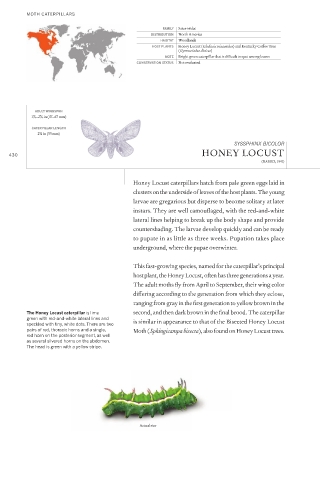
          The Honey Locust caterpillar is lime   second, and then dark brown in the  nal brood. The caterpillar
          green with red-and-white lateral lines and   is similar in appearance to that of the Bisected Honey Locust
          speckled with tiny, white dots. There are two
          pairs of red, thoracic horns and a single,   Moth (Sphingicampa bisecta), also found on Honey Locust trees.
          red horn on the posterior segment, as well
          as several silvered horns on the abdomen.
          The head is green with a yellow stripe.


                                              Actual size

