


Page 435 - The Book of Caterpillars: A Life-Size Guide to Six Hundred Species From Around the World
P. 435
MOTH CATERPILLARS

                      FAMILY  Sphingidae
                  DISTRIBUTION  Africa, the Azores, Europe (except the far north), the Middle
                           East, and western Asia; rare summer migrant to Iceland and
                           northern Europe
                     HABITAT  Cultivated areas and open scrub with solanaceous plants,
                           especially drier and sunnier locations
                  HOST PLANTS  Numerous Solanaceae, Bignoniaceae, Verbenaceae,
                           and Oleaceae, and several species from other families
                      NOTE  Horned caterpillar of a species steeped in myth and
                           superstition
             CONSERVATION STATUS  Not evaluated, but common in Africa


                                                                                   ADULT WINGSPAN
                                                                                  3½–5 in (90–130 mm)
                                                                                  CATERPILLAR LENGTH
                                                                                  4⅝–5 in (120–130 mm)
            ACHERONTIA ATROPOS
            DEATH’S HEAD HAWKMOTH                                                                433

            (LINNAEUS, 1758)


            Death’s Head Hawkmoth caterpillars hatch from green or
            gray-blue eggs, laid singly beneath old leaves of the host plant.
            Initially pale yellow with a disproportionately long horn, the
            larva turns dark green as it feeds. In the fourth instar, its coloring
            becomes more vivid, and, in the  nal instar, the horn takes on a

            downcurved shape. The mature caterpillar is large and lethargic
            but, if threatened, will click its mandibles and even try to bite.
            It can strip small plants bare and is an occasional local pest.

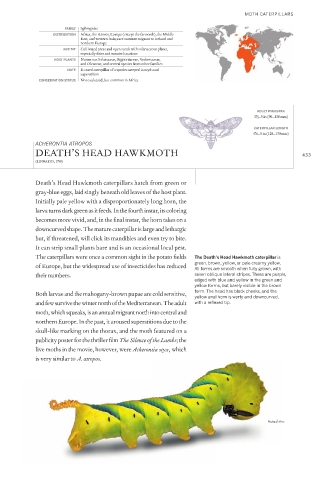
            The caterpillars were once a common sight in the potato  elds   The Death’s Head Hawkmoth caterpillar is
            of Europe, but the widespread use of insecticides has reduced   green, brown, yellow, or pale creamy yellow.
                                                               All forms are smooth when fully grown, with
            their numbers.                                     seven oblique lateral stripes. These are purple,
                                                               edged with blue and yellow in the green and
                                                               yellow forms, but barely visible in the brown
            Both larvae and the mahogany-brown pupae are cold sensitive,   form. The head has black cheeks, and the
                                                               yellow anal horn is warty and downcurved,
            and few survive the winter north of the Mediterranean. The adult   with a re  exed tip.
            moth, which squeaks, is an annual migrant north into central and
            northern Europe. In the past, it aroused superstitions due to the
            skull-like marking on the thorax, and the moth featured on a
            publicity poster for the thriller  lm The Silence of the Lambs; the

            live moths in the movie, however, were Acherontia styx, which
            is very similar to A. atropos.


                                                                                      Actual size

