


Page 436 - The Book of Caterpillars: A Life-Size Guide to Six Hundred Species From Around the World
P. 436
MOTH CATERPILLARS

                                                     FAMILY  Sphingidae
                                                 DISTRIBUTION  The tropics, subtropics, and temperate regions of the world
                                                          (excluding North and South America); rare summer migrant
                                                          to Iceland and northern Europe
                                                    HABITAT  Warm, dry cultivated areas and open scrub or steppe; during
                                                          migrations almost anywhere except dense forests
                                                  HOST PLANTS  Various Convolvulaceae, especially Convolvulus spp.,
                                                          Calystegia spp., and Ipomoea spp.
                                                      NOTE  Sluggish caterpillar of a noted migrant with spectacular

                                                           ying skills
                                             CONSERVATION STATUS  Not evaluated, but common in its range


            ADULT WINGSPAN
           3¾–5 in (95–130 mm)
           CATERPILLAR LENGTH
           4–4¼ in (100–110 mm)
                                                                           AGRIUS CONVOLVULI
                                              CONVOLVULUS HAWKMOTH
    434
                                                                                   (LINNAEUS, 1758)


                                            Convolvulus Hawkmoth caterpillars hatch from spherical eggs
                                            deposited singly on the upper side or underside of a host plant
                                            leaf. Hiding initially beneath a nearby leaf, the larvae slowly
                                            nibble holes through it. By the fourth instar, more is eaten,
                                            and growth accelerates. When fully grown, most (but not all)
                                            caterpillars hide by day and feed only at night. All are extremely
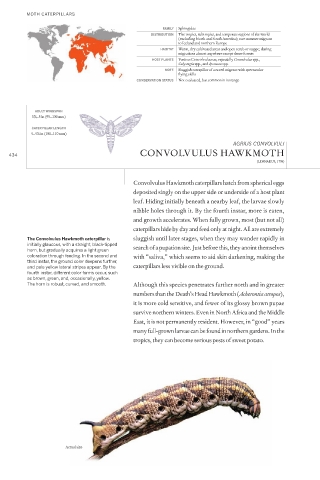
          The Convolvulus Hawkmoth caterpillar is   sluggish until later stages, when they may wander rapidly in
          initially glaucous, with a straight, black-tipped   search of a pupation site. Just before this, they anoint themselves
          horn, but gradually acquires a light green
          coloration through feeding. In the second and   with “saliva,” which seems to aid skin darkening, making the
          third instar, the ground color deepens further,
          and pale yellow lateral stripes appear. By the   caterpillars less visible on the ground.
          fourth instar, di  erent color forms occur, such
          as brown, green, and, occasionally, yellow.
          The horn is robust, curved, and smooth.  Although this species penetrates farther north and in greater
                                            numbers than the Death’s Head Hawkmoth (Acherontia atropos),
                                            it is more cold sensitive, and fewer of its glossy brown pupae
                                            survive northern winters. Even in North Africa and the Middle
                                            East, it is not permanently resident. However, in “good” years
                                            many full-grown larvae can be found in northern gardens. In the
                                            tropics, they can become serious pests of sweet potato.


                      Actual size

