


Page 434 - The Book of Caterpillars: A Life-Size Guide to Six Hundred Species From Around the World
P. 434
MOTH CATERPILLARS

                                                     FAMILY  Saturniidae
                                                 DISTRIBUTION  Western section of Great Escarpment from Cape Town,
                                                          South Africa, north to southern Namibia
                                                    HABITAT  Semidesert
                                                  HOST PLANTS  Eriocephalus spp.
                                                      NOTE  Caterpillar that rolls into a hairy ball when disturbed
                                             CONSERVATION STATUS  Not evaluated


            ADULT WINGSPAN
           1 ⁄  –1¾ in (30–45 mm)
           CATERPILLAR LENGTH
             1¾ in (45 mm)
                                                                              VEGETIA DUCALIS
                                                          DUCAL PRINCELING
    432
                                                                                     JORDAN, 1922


                                            Ducal Princeling silkmoth caterpillars hatch from eggs clustered
                                            around a twig on the host plant. Unlike most silkmoth species,
                                            the new hatchlings do not congregate but continuously wander
                                            around, nibbling on leaves at random. By the second instar,
                                            the dorsal hairs of the larva become very long, and when it is

                                            disturbed it rolls up in a hairy ball. At the end of the  fth instar,
                                            the caterpillar quickly spins a cocoon near the base of a bush,
                                            decorating it with dead leaves and debris.

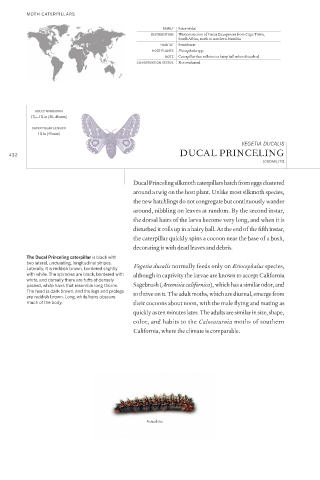
          The Ducal Princeling caterpillar is black with
          two lateral, undulating, longitudinal stripes.   Vegetia ducalis normally feeds only on Eriocephalus species,
          Laterally, it is reddish brown, bordered slightly
          with white. The spiracles are black, bordered with   although in captivity the larvae are known to accept California
          white, and dorsally there are tufts of densely
          packed, white hairs that resemble long thorns.   Sagebrush (Artemisia californica), which has a similar odor, and
          The head is dark brown, and the legs and prolegs   to thrive on it. The adult moths, which are diurnal, emerge from
          are reddish brown. Long, white hairs obscure

          much of the body.                 their cocoons about noon, with the male  ying and mating as
                                            quickly as ten minutes later. The adults are similar in size, shape,
                                            color, and habits to the Calosaturnia moths of southern
                                            California, where the climate is comparable.


                                                Actual size

