


Page 465 - The Book of Caterpillars: A Life-Size Guide to Six Hundred Species From Around the World
P. 465
MOTH CATERPILLARS

                      FAMILY  Sphingidae
                  DISTRIBUTION  Northeast India, Nepal, southwest China, northern Thailand,
                           and northern Vietnam
                     HABITAT  Mountainous forests and woodlands
                  HOST PLANTS  Unknown in the wild, but likely to be ivy (Ilex spp.), which the
                           caterpillar feeds on in captivity

                      NOTE  Well-camou aged montane hawkmoth caterpillar
             CONSERVATION STATUS  Not evaluated


                                                                                   ADULT WINGSPAN
                                                                                  4–4⅛ in (100–105 mm)
                                                                                  CATERPILLAR LENGTH
                                                                                  3–3⅜ in (75–85 mm)
            PENTATEUCHA CURIOSA
            HIRSUTE HAWKMOTH                                                                     463

            SWINHOE, 1908


            Hirsute Hawkmoth caterpillars hatch from eggs laid singly on
            host plants by the female just a few days after mating; the moths
            rarely live beyond  ve days. The eggs are relatively small for


            the size of moth and glossy jade green when  rst laid, turning
            shiny bronze within 36 hours and taking about 30 days to hatch.
            First instars rest on the underside of a leaf along the midrib and
            feed by eating the leaf tip backward, well camou aged by their

            leaf-green color. When not feeding, mature caterpillars cling
            on to the leaf using the last two sets of prolegs, with the anterior
            part of the body raised. Growth is rapid, with comparatively
            little food consumed.


            Pupation takes place underground in an earthen cell, with the
            dark brown pupa appearing to be vulnerable to desiccation. This

            species occurs in mountainous areas and  ies during winter and
            early spring. The adults eclose in early evening, and mating
            occurs immediately, the males presumably  nding females by

            locating and following pheromone trails.


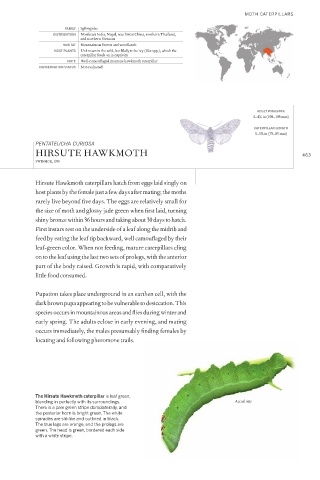
            The Hirsute Hawkmoth caterpillar is leaf green,
            blending in perfectly with its surroundings.                    Actual size
            There is a pale green stripe dorsolaterally, and
            the posterior horn is bright green. The white
            spiracles are slit-like and outlined in black.
            The true legs are orange, and the prolegs are
            green. The head is green, bordered each side
            with a white stripe.

