


Page 463 - The Book of Caterpillars: A Life-Size Guide to Six Hundred Species From Around the World
P. 463
MOTH CATERPILLARS

                      FAMILY  Sphingidae
                    TRIBUTION
                  DISTRIBUTION  Western areas of North America
                  DIS
                  DISTRIBUTION
                     HABITAT
                        A
                     HABITAT T  Wet woodlands, riparian forest, parks, and gardens
                     HABIT
                  HOST PLANTS S  Poplar (Populus spp.) and willow (Salix spp.)
                    T PLANT
                  HOST PLANTS
                  HOS
                      NOTE
                      NOTE
                      NO TE  Large, green caterpillar that has distinctive oblique stripes
             CONSERVATION STATUS
             CONSERVATION STATUS
             CONSERV A TION S T A TUS  Not evaluated
                                                                                   ADULT WINGSPAN
                                                                                  5–6½ in (130–165 mm)
                                                                                  CATERPILLAR LENGTH
                                                                                    3½ in (90 mm)
            PACHYSPHINX OCCIDENTALIS
            WESTERN POPLAR SPHINX                                                                461

            (HY. EDWARDS, 1875)


            The caterpillars of the Western Poplar Sphinx moth hatch from
            large, pale green eggs laid in small groups on the leaves of the

            host plant. The larvae feed on leaves for about  ve weeks before
            crawling to the ground, where they dig a shallow burrow in
            loose soil in which to pupate. The resulting pupa is brown. The
            species then overwinters in the burrow and ecloses in spring.

            Pachysphinx occidentalis is a nocturnal moth, on the wing from
            June to August in the northern part of the range with a single
            generation, while in the south of the range the moths are seen
            from May to September and there are two generations. The adult
            moths live for about six to ten days and do not feed, instead
            surviving on fats stored in the body. There are two known
            subspecies, one found in the south of the United States and
            the other in Mexico.


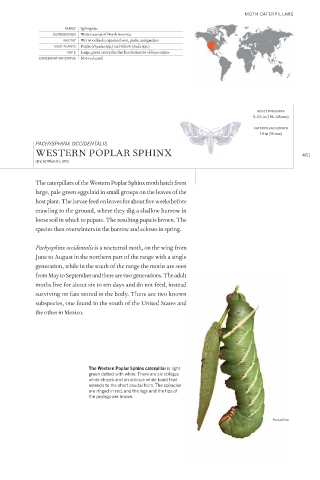
                             The Western Poplar Sphinx caterpillar is light
                             green dotted with white. There are six oblique
                             white stripes and an oblique white band that
                             extends to the short caudal horn. The spiracles
                             are ringed in red, and the legs and the tips of
                             the prolegs are brown.


                                                                                        Actual size

