


Page 462 - The Book of Caterpillars: A Life-Size Guide to Six Hundred Species From Around the World
P. 462
MOTH CATERPILLARS

                                                     FAMILY  Sphingidae
                                                 DISTRIBUTION  Temperate Europe to temperate west Asia and central Asia
                                                    HABITAT  Deciduous woodlands, open river-valley woodlands,
                                                          and warm, wet mountain scrub or woodlands
                                                  HOST PLANTS  Mainly trees of Tiliaceae (linden or lime), Betulaceae,
                                                          Ulmaceae, and Rosaceae families
                                                      NOTE  Caterpillar well adapted to suburban and urban gardens,
                                                          and parks
                                             CONSERVATION STATUS  Not evaluated, but common, especially in suburban areas


            ADULT WINGSPAN
           2⅜–3⅛ in (60–80 mm)
           CATERPILLAR LENGTH
           2⅛–2 ⁄   in (55–65 mm)
                                                                                 MIMAS TILIAE
                                                               LIME HAWKMOTH
    460
                                                                                   (LINNAEUS, 1758)


                                            The Lime Hawkmoth caterpillar generally feeds high in the
                                            crown of trees and large shrubs. It tends to rest motionless under
                                            a leaf, then creeps up to the leaf edge to feed, exposing no more
                                            than its moving head. Parks, cherry orchards, and avenues of
                                            urban and suburban trees can support large populations. Upward
                                            of 25 overwintering, twiglike, earth-colored pupae can be found
                                            at the base of host trees, just beneath surface debris. There are
                                            one or two generations a year.


                                            Changing in color to dull greenish pink and grayish brown,
                                            most larvae pupate at the base of the host, but some wander
                                            o  furiously in search of a suitable site, which is when they are

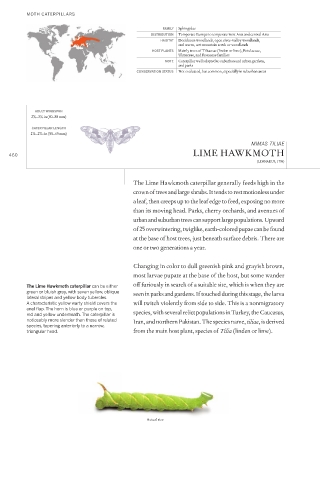
          The Lime Hawkmoth caterpillar can be either
          green or bluish gray, with seven yellow, oblique   seen in parks and gardens. If touched during this stage, the larva
          lateral stripes and yellow body tubercles.
          A characteristic yellow warty shield covers the   will twitch violently from side to side. This is a nonmigratory
          anal   ap. The horn is blue or purple on top,   species, with several relict populations in Turkey, the Caucasus,
          red and yellow underneath. The caterpillar is
          noticeably more slender than those of related   Iran, and northern Pakistan. The species name, tiliae, is derived
          species, tapering anteriorly to a narrow,
          triangular head.                  from the main host plant, species of Tilia (linden or lime).


                                                Actual size

