


Page 460 - The Book of Caterpillars: A Life-Size Guide to Six Hundred Species From Around the World
P. 460
MOTH CATERPILLARS

                                                     FAMILY  Sphingidae
                                                 DISTRIBUTION  North and South America, from Canada to Argentina and
                                                          the Caribbean

                                                    HABITAT  Wide variety, including vegetable patches and tobacco  elds
                                                  HOST PLANTS  Solanaceae, such as tobacco (Nicotiana spp.), Tomato (Solanum
                                                          lycopersicum), and Datura spp.
                                                      NOTE  Caterpillar that is used as a model organism in biological sciences
                                             CONSERVATION STATUS  Not evaluated, but common


            ADULT WINGSPAN
             4 in (100 mm)
           CATERPILLAR LENGTH
             2¾ in (70 mm)
                                                                              MANDUCA SEXTA
                                                      TOBACCO HORNWORM
    458
                                                                                   (LINNAEUS, 1763)


                                            Tobacco Hornworm caterpillars normally develop through  ve

                                            larval instars but may molt additional times if the nutritional
                                            value of their food is poor. Mature larvae wander, change
                                            color, and lose excess liquid before pupation, which occurs
                                            in an underground chamber; as with most other sphinx moths,
                                            no cocoon is made. The life cycle can be completed within
                                            50 days but is often longer because many pupae will enter
                                            diapause during hot summer months. There may be up to four

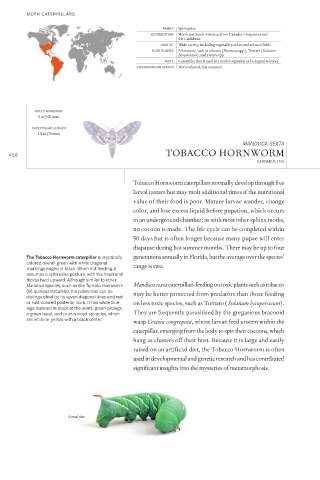
         The Tobacco Hornworm caterpillar is cryptically   generations annually in Florida, but the average over the species’
         colored overall green with white diagonal   range is two.
         markings edged in black. When not feeding, it
         assumes a sphinxlike posture, with the head and
         thorax held upward. Although similar to other
         Manduca species, such as the Tomato Hornworm   Manduca sexta caterpillars feeding on toxic plants such as tobacco
         (M. quinquemaculata), the caterpillar can be   may be better protected from predators than those feeding
         distinguished by its seven diagonal lines and red
         or rust-colored posterior horn. It has white true   on less toxic species, such as Tomato (Solanum lycopersicum).
         legs, banded in black at the joints, green prolegs,
         a green head, and pronounced spiracles, which   They are frequently parasitized by the gregarious braconid
         are white or yellow with a black center.   wasp Cotesia congregata, whose larvae feed unseen within the
                                            caterpillar, emerging from the body to spin their cocoons, which
                                            hang as clusters off their host. Because it is large and easily
                                            raised on an artificial diet, the Tobacco Hornworm is often
                                            used in developmental and genetic research and has contributed

                                            signi cant insights into the mysteries of metamorphosis.


                       Actual size

