


Page 467 - The Book of Caterpillars: A Life-Size Guide to Six Hundred Species From Around the World
P. 467
MOTH CATERPILLARS

                      FAMILY  Sphingidae
                  DISTRIBUTION  Russian Far East, eastern and central China, Chinese Taipei,
                           Korean peninsula, and Japan
                     HABITAT  Forest edges, open parklands, and woodlands
                  HOST PLANTS  Chinese Hickory (Carya cathayensis) and Manchurian Walnut
                           (Juglans mandshurica)
                      NOTE  Noisy hawkmoth caterpillar that will hiss and squeak if disturbed
             CONSERVATION STATUS  Not evaluated


                                                                                   ADULT WINGSPAN
                                                                                  3  ⁄  –5 in (93–130 mm)
                                                                                  CATERPILLAR LENGTH
                                                                                  2 ⁄  –3⅜ in (65–85 mm)
            PHYLLOSPHINGIA DISSIMILIS
            BUFF LEAF HAWKMOTH                                                                   465

            BREMER, 1861


            Bu  Leaf Hawkmoth caterpillars hatch from eggs laid singly or

            in small groups by the female hawkmoth; the eggs are pale olive
            green when freshly laid. Developing through  ve instars in as

            little as three weeks, these caterpillars are generally sedentary,
            feeding on lower branches of the host plant usually 6½–13 ft
            (2–4 m) above the ground. When disturbed, the larvae thrash
            out laterally, making a squeaking or hissing sound to dissuade
            predators. When full grown, the caterpillars darken in color and
            move to the ground, where they build a silk-free cell among
            debris, within which they pupate. Unusually, the pupae also
            hiss or squeak.


            The caterpillars are most often found in July and August, with
            one generation annually in northern areas of its range and
            possibly two generations in the south. There are currently just
            two species within the genus Phyllosphingia, although others

            may be identi ed using molecular techniques.


                                     Actual size


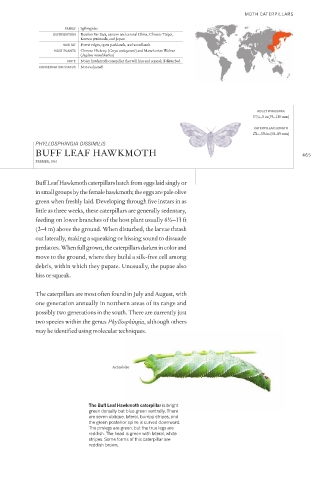
                             The Bu  Leaf Hawkmoth caterpillar is bright
                             green dorsally but blue green ventrally. There
                             are seven oblique, lateral, bumpy stripes, and
                             the green posterior spine is curved downward.
                             The prolegs are green, but the true legs are
                             reddish. The head is green with lateral, white
                             stripes. Some forms of this caterpillar are
                             reddish brown.

