


Page 466 - The Book of Caterpillars: A Life-Size Guide to Six Hundred Species From Around the World
P. 466
MOTH CATERPILLARS

                                                     FAMILY  Sphingidae
                                                 DISTRIBUTION  India, Nepal, Sri Lanka, Thailand, eastern and southern China,
                                                          Chinese Taipei, Japan, Malaysia, Indonesia, and the Philippines
                                                    HABITAT  Various, from open woodlands to metropolitan areas, roadsides,
                                                          and gardens
                                                  HOST PLANTS  Grapevine (Vitis spp.), Cissus spp., Leea spp., Begonia spp.,
                                                          Di  enbachia spp., and elephant ear (Caldium spp., Colocasia spp.)

                                                      NOTE  Hawkmoth caterpillar that has in atable eyespots to frighten
                                                          o  predators

                                             CONSERVATION STATUS  Not evaluated


            ADULT WINGSPAN
           2½–3⅛ in (64–80 mm)
           CATERPILLAR LENGTH
           2¾–3 in (70–75 mm)
                                                                              PERGESA ACTEUS
                                            GREEN PERGESA HAWKMOTH
    464
                                                                                    (CRAMER, 1779)


                                            Green Pergesa Hawkmoth caterpillars hatch from eggs that
                                            are green, shiny, broadly oval, and laid singly on the host
                                            plants by the female hawkmoth. The larvae come in two color
                                            forms—green or brown—from the fourth instar, but their
                                            markings remain the same. Occasionally, a red form is seen. The
                                            caterpillars develop rapidly through the instars, taking about a
                                            month before they darken in color and wander to the ground to
                                            seek a subterranean pupation site. Pupation occurs in an earthen
                                            cell and the pupa is pale brown.


                                            Adults  y at night but are particularly active around daybreak

                                            and during rainy weather and have been observed drinking
                                            from puddles. The caterpillar uses false eyespots as a defensive
                                            strategy, increasing their size when threatened. Although
                                            well camouflaged and able to ward off potential vertebrate
                                            enemies with these false eyes, many Green Pergesa Hawkmoth
                                            caterpillars fall victim to parasitic ichneumonid wasps.


                                                        Actual size


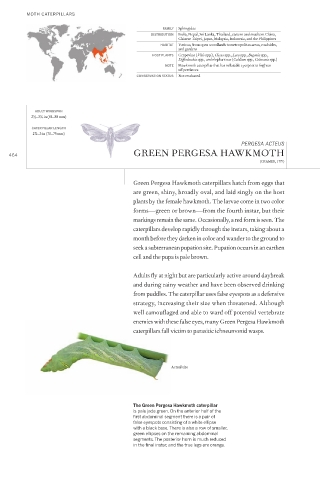
                                            The Green Pergesa Hawkmoth caterpillar
                                            is pale jade green. On the anterior half of the
                                              rst abdominal segment there is a pair of
                                            false eyespots consisting of a white ellipse
                                            with a black base. There is also a row of smaller,
                                            green ellipses on the remaining abdominal
                                            segments. The posterior horn is much reduced
                                            in the   nal instar, and the true legs are orange.

