


Page 461 - The Book of Caterpillars: A Life-Size Guide to Six Hundred Species From Around the World
P. 461
MOTH CATERPILLARS

                      FAMILY  Sphingidae
                  DISTRIBUTION  Russia, Mongolia, China, Chinese Taipei, Hong Kong,
                           Korea, and Japan
                     HABITAT  Many habitats, including montane forests, cities, and orchards
                  HOST PLANTS  Fruit trees, including apple (Malus spp.), pear (Pyrus spp.),
                           plum (Prunus spp.), and hawthorn (Crataegus spp.)
                      NOTE  Asian hawkmoth caterpillar that can be a tree fruit pest
             CONSERVATION STATUS  Not evaluated, but usually common


                                                                                   ADULT WINGSPAN
                                                                                  2¾–3⅝ in (70–92 mm)


                                                                                  CATERPILLAR LENGTH
                                                                                  3–3¼ in (75–83 mm)
            MARUMBA GASCHKEWITSCHII
            MARUMBA GASCHKEWITSCHII                                                              459

            (BREMER & GREY, 1853)


            Marumba gaschkewitschii caterpillars hatch from translucent,
            jade-green eggs laid singly or in small groups of two to
            four on host plant leaves. The female usually oviposits on
            bushes or small trees, and the larvae tend to feed at about
            1¾–5 ft (0.5–1.5 m) above the ground. Development is rapid,
            and the caterpillars are well camou aged on their host plant.

            The first few instars rest and feed stretched out along the
            midrib under a leaf. The larvae go through  ve to seven instars.

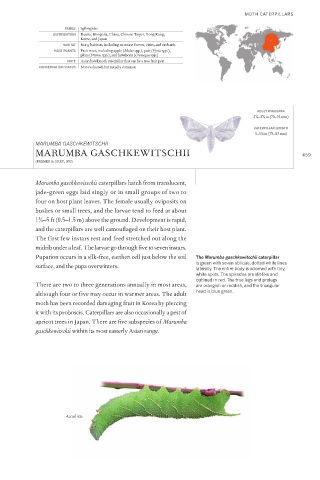
            Pupation occurs in a silk-free, earthen cell just below the soil   The Marumba gaschkewitschii caterpillar
            surface, and the pupa overwinters.                  is green with seven oblique, dotted white lines
                                                                laterally. The entire body is adorned with tiny,
                                                                white spots. The spiracles are slit-like and
                                                                outlined in red. The true legs and prolegs
            There are two to three generations annually in most areas,   are orangish or reddish, and the triangular
            although four or five may occur in warmer areas. The adult   head is blue green.
            moth has been recorded damaging fruit in Korea by piercing
            it with its proboscis. Caterpillars are also occasionally a pest of

            apricot trees in Japan. There are  ve subspecies of Marumba
            gaschkewitschii within its most easterly Asian range.


                      Actual size

