


Page 464 - The Book of Caterpillars: A Life-Size Guide to Six Hundred Species From Around the World
P. 464
MOTH CATERPILLARS

                                                     FAMILY  Sphingidae
                                                 DISTRIBUTION  Korea, Japan, south to Chinese Taipei, and throughout eastern
                                                          and central China to Southeast Asia
                                                    HABITAT  Forests and woodlands
                                                  HOST PLANTS  Paper Mulberry (Broussonetia papyrifera), other Broussonetia
                                                          spp.,White Mulberry (Morus alba), and Maclura fruticosa
                                                      NOTE  Unique Southeast Asian hawkmoth species that has no
                                                          close relatives
                                             CONSERVATION STATUS  Not evaluated


            ADULT WINGSPAN
           2⅜–3½ in (60–90 mm)
           CATERPILLAR LENGTH
            2–2¾ in (50–70 mm                                                PARUM COLLIGATA
                                                              PAPER MULBERRY
                                                                       HAWKMOTH
    462
                                                                                    (WALKER, 1856)


                                            Paper Mulberry Hawkmoth caterpillars hatch from eggs laid
                                            in small masses on the underside of host plant leaves. When
                                            first laid by the female hawkmoth, the eggs are whitish but
                                            turn yellow prior to hatching in about a week. The caterpillars
                                            develop quickly and take about a month to reach pupation, which
                                            occurs in a subterranean earthen cell. The adult hawkmoths
                                            emerge in as little as 10 to 12 days during warmer times of the
                                            year, but the pupae may overwinter in northerly areas.


                                            There are one to two generations a year in northern China, with
                                            adults on the wing from May to July. Farther south there may
                                            be up to four generations annually with no winter dormancy.
                                            Like many hawkmoth larvae, caterpillars of the Paper Mulberry
                                            Hawkmoth are often parasitized by small wasps that develop
                                            within the caterpillar, emerging to pupate in tiny cocoons
                                            festooned around the now-dead larva. Parum colligata is the
                                            only species of its genus.


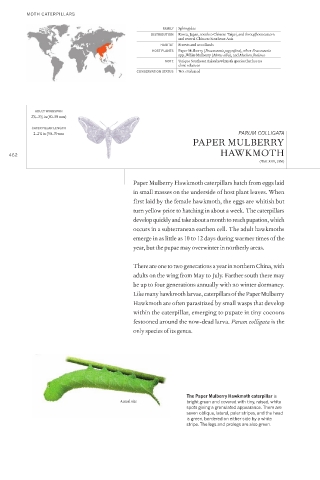
                                                             The Paper Mulberry Hawkmoth caterpillar is
                                       Actual size           bright green and covered with tiny, raised, white
                                                             spots giving a granulated appearance. There are
                                                             seven oblique, lateral, paler stripes, and the head
                                                             is green, bordered on either side by a white
                                                             stripe. The legs and prolegs are also green.

