


Page 469 - The Book of Caterpillars: A Life-Size Guide to Six Hundred Species From Around the World
P. 469
MOTH CATERPILLARS

                      FAMILY  Sphingidae
                  DISTRIBUTION  South Asia, Southeast Asia to northeast China, Korea, and Japan
                     HABITAT  Forest edges, parks, and gardens
                  HOST PLANTS  Various shrubs and small trees, including Ligustrum spp.,
                           Syringa spp., and Paulownia spp.
                      NOTE  Caterpillar that has two distinct color forms when mature
             CONSERVATION STATUS  Not evaluated, but not threatened


                                                                                   ADULT WINGSPAN
                                                                                  3½–4¾ in (90–122 mm)
                                                                                  CATERPILLAR LENGTH
                                                                                  2¾–4¼ in (70–110 mm)
            PSILOGRAMMA INCRETA
            PLAIN GRAY HAWKMOTH                                                                  467

            (WALKER, 1865)


            The Plain Gray Hawkmoth lays its eggs singly on the leaves
            of the host plant. Initially pale green, the eggs become yellow
            brown as hatching approaches. The emerging caterpillars are
            yellow with a black horn, becoming greener in color as they
            develop. They feed on the leaves of their host plants and, at rest,
            can be found on the underside of large leaves on lower branches.
            The caterpillars move to the ground, where they burrow
            into the soil and pupate.


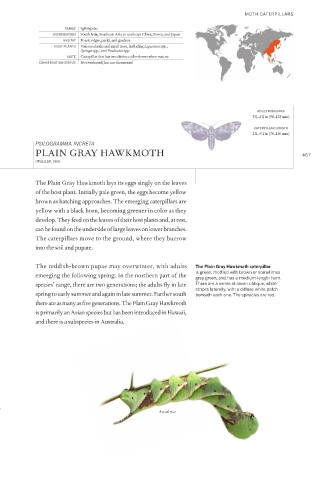
            The reddish-brown pupae may overwinter, with adults   The Plain Gray Hawkmoth caterpillar
            emerging the following spring. In the northern part of the   is green, mottled with brown or sometimes
                                                               gray green, and has a medium-length horn.

            species’ range, there are two generations; the adults  y in late   There are a series of seven oblique, white
            spring to early summer and again in late summer. Farther south   stripes laterally, with a di  use white patch
                                                               beneath each one. The spiracles are red.
            there are as many as  ve generations. The Plain Gray Hawkmoth

            is primarily an Asian species but has been introduced in Hawaii,
            and there is a subspecies in Australia.


                                                    Actual size

