


Page 471 - The Book of Caterpillars: A Life-Size Guide to Six Hundred Species From Around the World
P. 471
MOTH CATERPILLARS

                      FAMILY  Sphingidae
                  DISTRIBUTION  From western Russia to Russian Far East, Mongolia, northeast
                           China, South Korea, and northern Japan
                     HABITAT  Grassy, mixed, boreal forests, clearings, swamps, and streams
                  HOST PLANTS  Poplar (Populus spp.) and willow (Salix spp.)
                      NOTE  Caterpillar that fools predators by adopting a sphinxlike pose
             CONSERVATION STATUS  Not evaluated


                                                                                   ADULT WINGSPAN
                                                                                  2–2¾ in (50–70 mm)
                                                                                  CATERPILLAR LENGTH
            SMERINTHUS CAECUS                                                     2⅜–2¾ in (60–70 mm)
            NORTHERN EYED
            HAWKMOTH                                                                             469

            MÉNÉTRIÉS, 1857


            Female Northern Eyed Hawkmoths lay shiny, green eggs singly
            or in small groups of up to 12 on the underside of host plant
            leaves. Within seven to eight days, the caterpillars hatch and
            begin feeding, usually on willow species. They develop between
            July and September before overwintering as brown-black pupae
            in earthen cells below the ground. The hawkmoth adults are on
            the wing in May and June in a single brood, although a second
            generation may occur in southern parts of the species’ range.


            The caterpillar’s defense is based on camou age and its adoption
            of a sphinxlike posture when resting, which breaks up the
            caterpillar outline, fooling birds foraging for a conventionally
            worm-shaped caterpillar. However, parasitic   ies and wasps
            likely kill a great many Northern Eyed Hawkmoth caterpillars.
            The species is closely related to the more widespread Eyed
            Hawkmoth (Smerinthus ocellatus), and both larvae and adults
            are very similar in appearance.


                                                                         Actual size
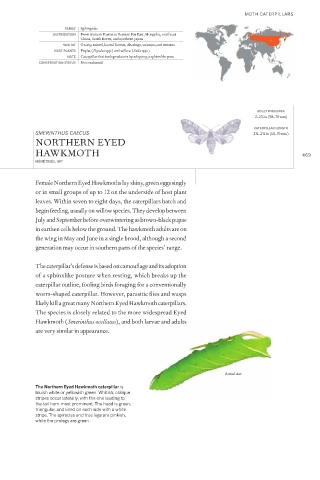
            The Northern Eyed Hawkmoth caterpillar is
            bluish white or yellowish green. Whitish, oblique
            stripes occur laterally, with the one leading to
            the tail horn most prominent. The head is green,
            triangular, and lined on each side with a white
            stripe. The spiracles and true legs are pinkish,
            while the prolegs are green.

