


Page 472 - The Book of Caterpillars: A Life-Size Guide to Six Hundred Species From Around the World
P. 472
MOTH CATERPILLARS

                                                     FAMILY  Sphingidae
                                                 DISTRIBUTION  Temperate Europe, northwest Africa, west Asia, central Asia,
                                                          and western Mongolia
                                                    HABITAT  Riverine shingle bars, wet river valleys, damp woodland edges,
                                                          apple orchards, coastal sandhills, and suburban gardens
                                                  HOST PLANTS  Mainly poplar (Populus spp.), willow (Salix spp.), and apple
                                                          (Malus spp.); also some Prunus spp.
                                                      NOTE  Caterpillar that parasitoids ravage, killing up to
                                                          80 percent annually
                                             CONSERVATION STATUS  Not evaluated, but common, especially in open areas with willows


            ADULT WINGSPAN
           2¾–3¾ in (70–95 mm)
           CATERPILLAR LENGTH
           2¾–3½ in (70–90 mm)
                                                                        SMERINTHUS OCELLATUS
                                                             EYED HAWKMOTH
    470
                                                                                   (LINNAEUS, 1758)


                                            In open sunny areas, cryptic Eyed Hawkmoth larvae feed quite
                                            openly on the tips of new shoots. One large caterpillar can
                                            strip several shoots bare; before the use of organic pesticides,
                                            the larvae would sometimes devastate apple orchards. The
                                            caterpillar is a “sit and hide” species, mimicking leaves when at
                                            rest, and taking on the same hue as the leaves around it. Many
                                            larvae avoid detection by birds by sitting upside down and using
                                            superb body countershading, although most fall victim to the
                                            Microplitis ocellatae parasitic wasp.


                                            In warmer parts of Europe, there are two or three broods
                                            annually, but larvae numbers can  uctuate markedly from year

                                            to year, and local populations may die out. If disturbed, the adult
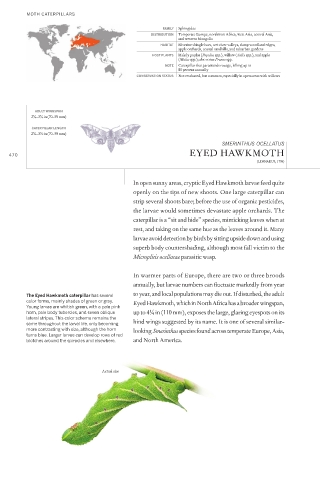
         The Eyed Hawkmoth caterpillar has several
         color forms, mainly shades of green or gray.   Eyed Hawkmoth, which in North Africa has a broader wingspan,
         Young larvae are whitish green, with a pale pink
         horn, pale body tubercles, and seven oblique   up to 4¼ in (110 mm), exposes the large, glaring eyespots on its
         lateral stripes. This color scheme remains the
         same throughout the larval life, only becoming   hind wings suggested by its name. It is one of several similar-
         more contrasting with size, although the horn   looking Smerinthus species found across temperate Europe, Asia,
         turns blue. Larger larvae can develop rows of red
         blotches around the spiracles and elsewhere.  and North America.


                                  Actual size

