


Page 474 - The Book of Caterpillars: A Life-Size Guide to Six Hundred Species From Around the World
P. 474
MOTH CATERPILLARS

                                                     FAMILY  Sphingidae
                                                 DISTRIBUTION  Eastern states of Canada and United States
                                                    HABITAT  Woodlands, parks, and gardens
                                                  HOST PLANTS  Various, including laurel (Kalmia spp.), lilac (Syringa spp.),
                                                          ash (Fraxinus spp.), and Fringetree (Chionanthus virginicus)
                                                      NOTE  Bright green caterpillar that has distinct lateral, oblique lines
                                             CONSERVATION STATUS  Not evaluated, but not threatened


            ADULT WINGSPAN
           3–4⅛ in (75–105 mm)
           CATERPILLAR LENGTH
             2     in (65 mm)
                                                                               SPHINX KALMIAE
                                                                  LAUREL SPHINX
    472
                                                                                    J. E. SMITH, 1797


                                            The female Laurel Sphinx moth lays her smooth, oval, green-
                                            white eggs on leaves of the host plants. The emerging young
                                            caterpillars are pale white with a black horn, becoming greener
                                            with age. They feed on the underside of leaves, where they
                                            are well camouflaged. However, they are vulnerable to
                                            attack from parasitoids. The mature caterpillars crawl to the
                                            ground, where they burrow into loose soil to pupate. They can
                                            overwinter as pupae.


                                            The adult moths are on the wing in summer. There is a single
                                            brood in the northern parts of the range, but there may be two
                                            or more broods in the south. The genus Sphinx is named for the
                                            sphinx of mythology—probably for the sphinxlike pose that

                                            caterpillars of this genus take when they raise their head o  the
                                            ground and tuck it into their thorax. The species name, kalmiae,
                                            may be derived from the laurel host plant but more probably
                                            from the Swedish botanist Pehr Kalm (1716–79).


                 Actual size
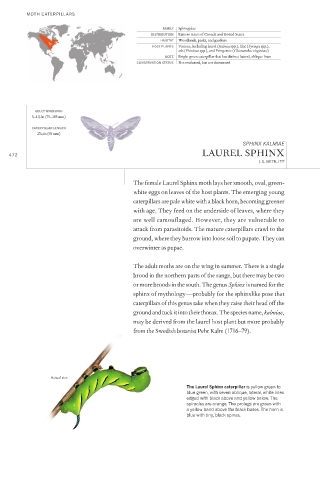
                                                             The Laurel Sphinx caterpillar is yellow green to
                                                             blue green, with seven oblique, lateral, white lines
                                                             edged with black above and yellow below. The
                                                             spiracles are orange. The prolegs are green with
                                                             a yellow band above the black bases. The horn is
                                                             blue with tiny, black spines.

