


Page 473 - The Book of Caterpillars: A Life-Size Guide to Six Hundred Species From Around the World
P. 473
MOTH CATERPILLARS

                      FAMILY  Sphingidae
                  DISTRIBUTION  North America, southern Canada to central United States
                     HABITAT  Many, including riparian areas, canyons, savannahs, and
                           shrublands, but particularly associated with forested woodlots
                  HOST PLANTS  Wild cherry and plum (Prunus spp.), lilac (Syringa spp.),
                           hackberry (Celtis spp.), apple (Malus spp.), and serviceberry
                           (Amelanchier spp.)
                      NOTE  Hawkmoth caterpillar that becomes an important pollinator
                           of rare orchids
             CONSERVATION STATUS  Not evaluated, but often uncommon


                                                                                   ADULT WINGSPAN
                                                                                  3⅜–4¼ in (85–110 mm)
                                                                                  CATERPILLAR LENGTH
                                                                                  3⅛–3½ in (80–90 mm)
            SPHINX DRUPIFERARUM
            WILD CHERRY SPHINX                                                                   471

            J. E. SMITH, 1797


            Wild Cherry Sphinx caterpillars hatch from a few hundred
            eggs laid singly by the female moth on both surfaces of host
            plant leaves. The eggs hatch about a week after they have been
            laid. The caterpillars feed rapidly and ravenously on their host
            plant and complete development within a month. To avoid
            predation they hide in the day and feed by night. However,
            many are parasitized by braconid wasps. Mature larvae form
            pupae in earthen cells about 4 in (100 mm) below the ground
            and overwinter there. In some cases, the pupal stage extends as
            long as two years.


            There is a single brood annually with the large hawkmoth adults,

            which are frequently found at  owers such as honeysuckles,

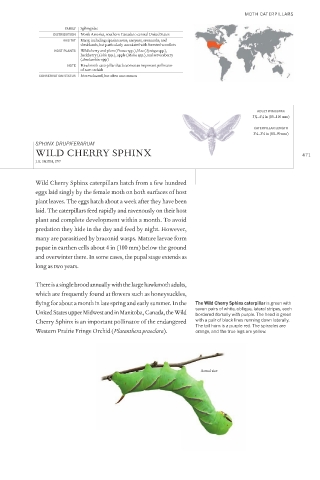
             ying for about a month in late spring and early summer. In the   The Wild Cherry Sphinx caterpillar is green with
            United States upper Midwest and in Manitoba, Canada, the Wild   seven pairs of white, oblique, lateral stripes, each
                                                               bordered dorsally with purple. The head is green
            Cherry Sphinx is an important pollinator of the endangered   with a pair of black lines running down laterally.
            Western Prairie Fringe Orchid (Platanthera praeclara).  The tail horn is a purple red. The spiracles are
                                                               orange, and the true legs are yellow.


                                                                 Actual size

