


Page 52 - The Book of Caterpillars: A Life-Size Guide to Six Hundred Species From Around the World
P. 52
BUTTERFLY CATERPILLARS

                                                     FAMILY  Papilionidae
                                                 DISTRIBUTION  Arabian peninsula, across southern Asia to China, Southeast Asia,
                                                          Papua New Guinea, and Australia; recent introductions into
                                                          Turkey, Dominican Republic, Puerto Rico, Jamaica, and Cuba
                                                    HABITAT  Diverse, including savannahs, forests, riverbeds, and gardens,
                                                          up to 6,900 ft (2,100 m) elevation
                                                  HOST PLANTS  Citrus spp. and scurf pea (Cullen spp.)
                                                      NOTE  Caterpillar that invades Citrus and is an occasional pest
                                             CONSERVATION STATUS  Not evaluated, but common over a wide geographic range


            ADULT WINGSPAN
             2¹³∕₁₆ in (72 mm)
           CATERPILLAR LENGTH
             1⅝ in (42 mm)
                                                                             PAPILIO DEMOLEUS
                                                          LIME SWALLOWTAIL
    50
                                                                                    LINNAEUS, 1758


                                            Young caterpillars of the Lime Swallowtail resemble bird
                                            droppings and are usually ignored by predators. Late instars are
                                            mostly green and camouflaged on their food plants until their last

                                            molt, when they seek shelter as they feed. Development from
                                            egg to adult takes 26 to 59 days. In colder climates the pupae may
                                            overwinter, extending the generation time to several months.
                                            Known as the Chequered Swallowtail in Australia, where it
                                            feeds on scurf peas, the species will develop on Citrus species if
                                            caterpillars are placed on the plant.


                                            The Lime Swallowtail has increased its range in the past decade
                                            or so, due to its strong flight and the expansion of agriculture

                                            and urbanization. It has also been recorded from Portugal
                                            (a single adult, in 2012) and continues to spread, becoming the
                                            most widespread swallowtail in the world. The caterpillars are
                                            a pest in Citrus stock nurseries from the Middle East to India, and
                                            they are a potential threat to Citrus growing elsewhere.


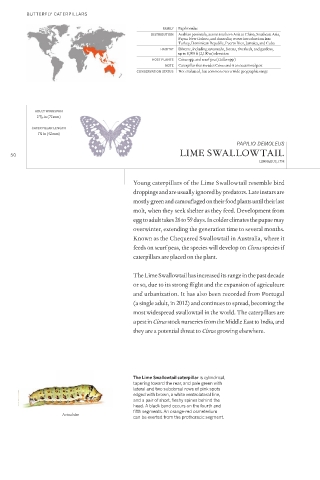
                                            The Lime Swallowtail caterpillar is cylindrical,
                                            tapering toward the rear, and pale green with
                                            lateral and two subdorsal rows of pink spots
                                            edged with brown, a white ventrolateral line,
                                            and a pair of short,   eshy spines behind the
                                            head. A black band occurs on the fourth and
                                              fth segments. An orange-red osmeterium
                     Actual size
                                            can be everted from the prothoracic segment.

