


Page 475 - The Book of Caterpillars: A Life-Size Guide to Six Hundred Species From Around the World
P. 475
MOTH CATERPILLARS

                      FAMILY  Sphingidae
                  DISTRIBUTION  Temperate Europe and northwest Africa to temperate western
                           Asia, central Asia, Siberia, Russian Far East, northern China,
                           and northern Japan
                     HABITAT  Open scrub and woodland edges, including town suburbs
                           and river valleys, but only north-facing slopes of mountains
                           in the south
                  HOST PLANTS  Mainly privet (Ligustrum spp.), ash (Fraxinus spp.), and lilac
                           (Syringa spp.); also many Spiraea spp. and Viburnum spp.
                      NOTE  Striking caterpillar of a very widely distributed Old
                           World hawkmoth
             CONSERVATION STATUS  Not evaluated, but common and widespread


                                                                                   ADULT WINGSPAN
                                                                                  3½–4⅝ in (90–120 mm)
                                                                                  CATERPILLAR LENGTH
                                                                                  3½–4 in (90–100 mm)
            SPHINX LIGUSTRI
            PRIVET HAWKMOTH                                                                      473

            LINNAEUS, 1758


            Privet Hawkmoth caterpillars hatch from up to 200 eggs laid
            singly by the female hawkmoth on the underside of leaves.
            The early instar larvae rest beneath the midrib of a leaf, but
            when fully grown assume a typical upside-down, sphinxlike
            pose, clinging to a petiole or stem by their rear legs, with the
            thoracic segments hunched. Most larvae grasp stripped shoots
            within 6½ ft (2 m) of the ground. Between four and seven weeks
            after hatching, the caterpillar turns purplish brown dorsally
            and moves to the ground to pupate in an earthern cell within
            soft, loamy soil.


            The pupae overwinter, and the adults eclose in June in northern
            parts of their range but earlier in the south, with a second
            generation in August. Adults are not very variable, although
            there are pale forms and sometimes individuals without any
            pink coloration. Several closely related species inhabit North
            America and Japan, notably the Wild Cherry Sphinx (Sphinx
            drupiferarum) and S. constricta. The species name, ligustri,
            is derived from one of its main hosts, privet.


                                                                                          Actual size
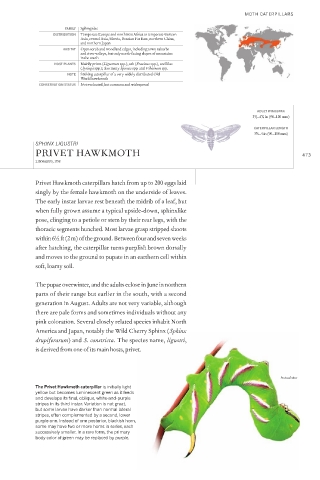
            The Privet Hawkmoth caterpillar is initially light
            yellow but becomes luminescent green as it feeds
            and develops its   nal, oblique, white-and-purple
            stripes in its third instar. Variation is not great,
            but some larvae have darker than normal lateral
            stripes, often complemented by a second, lower
            purple one. Instead of one posterior, blackish horn,
            some may have two or more horns in series, each
            successively smaller. In a rare form, the primary
            body color of green may be replaced by purple.

