


Page 476 - The Book of Caterpillars: A Life-Size Guide to Six Hundred Species From Around the World
P. 476
MOTH CATERPILLARS

                                                     FAMILY  Sphingidae
                                                 DISTRIBUTION  Most of Europe (except Iberia, Ireland, Scotland, and northern
                                                          Scandinavia), the Caucasus, southern Turkey, Lebanon, Russia,
                                                          western Siberia, and northern Kazakhstan
                                                    HABITAT  Pine forests, gardens, and parks
                                                  HOST PLANTS  Mainly pines, including Scots Pine (Pinus silvestris), Swiss Pine
                                                          (Pinus cembra), Norway Spruce (Picea abies), and Siberian
                                                          Spruce (Picea obovata); also cedars (Cedrus spp.) and European
                                                          Larch (Larix decidua)

                                                      NOTE  Well-camou aged caterpillar that feeds on pines
                                             CONSERVATION STATUS  Not evaluated, but considered secure within its range


            ADULT WINGSPAN
           2¾–3¾ in (70–96 mm)
           CATERPILLAR LENGTH
           3–3⅛ in (75–80 mm)
                                                                              SPHINX PINASTRI
                                                               PINE HAWKMOTH
    474
                                                                                   (LINNAEUS, 1758)


                                            Pine Hawkmoth caterpillars hatch from around 100 pale yellow
                                            eggs laid on pine needles or twigs and immediately consume
                                            their eggshell. At  rst they are a dull yellow with a large head

                                            and prominent forked horn but become green in color as they
                                            feed, with light yellow stripes at the second instar, creating an
                                            e ective camou age. Early instars feed only on the surface of


                                            a needle, but later instars consume the entire needle from tip
                                            to base. After four to eight weeks, when full grown, the larvae
                                            become restless, descend to the ground, and often wander some

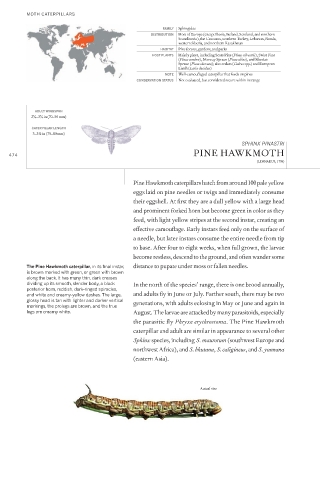
          The Pine Hawkmoth caterpillar, in its   nal instar,   distance to pupate under moss or fallen needles.
          is brown marked with green, or green with brown
          along the back. It has many thin, dark creases
          dividing up its smooth, slender body, a black   In the north of the species’ range, there is one brood annually,
          posterior horn, reddish, dark-ringed spiracles,

          and white and creamy-yellow dashes. The large,   and adults  y in June or July. Farther south, there may be two
          glossy head is tan with lighter and darker vertical   generations, with adults eclosing in May or June and again in
          markings, the prolegs are brown, and the true
          legs are creamy white.            August. The larvae are attacked by many parasitoids, especially
                                            the parasitic fly Phryxe erythrostoma. The Pine Hawkmoth
                                            caterpillar and adult are similar in appearance to several other
                                            Sphinx species, including S. maurorum (southwest Europe and
                                            northwest Africa), and S. bhutana, S. caligineus, and S. yunnana
                                            (eastern Asia).


                                                                 Actual size

