


Page 477 - The Book of Caterpillars: A Life-Size Guide to Six Hundred Species From Around the World
P. 477
MOTH CATERPILLARS

                      FAMILY  Sphingidae
                  DISTRIBUTION  Across Canada, from southern British Columbia to
                           Newfoundland, and northeastern United States
                     HABITAT  Boggy areas, coastal barrens, and deciduous forests
                  HOST PLANTS  Apple (Malus spp.), blueberries and huckleberries (Vaccinium
                           spp.), alder (Alnus spp.), Carolina Rose (Rosa carolina), American
                           Larch (Larex laricina), and White Spruce (Picea glauca)
                      NOTE  Canada’s commonest hawkmoth caterpillar
             CONSERVATION STATUS  Not evaluated, but usually common


                                                                                   ADULT WINGSPAN
                                                                                 2  ⁄  –3¾ in (68–95 mm)
                                                                                  CATERPILLAR LENGTH
                                                                                  2¾–3⅛ in (70–80 mm)
            SPHINX POECILA
            NORTHERN APPLE SPHINX                                                                475

            STEPHENS, 1828


            Northern Apple Sphinx caterpillars hatch from green eggs that
            are laid singly by the female hawkmoth on host plant leaves;
            the eggs hatch within a week of laying. The caterpillars,
            which are most common between April and September, live
            and feed solitarily, usually during daylight hours, concealing
            themselves beneath the leaves. Final instar caterpillars occur
            in three color forms: green, wine red, and an intermediate
            form that is a mottled combination of the wine color and green.
            Pupation occurs in a shallow, subterranean chamber, and
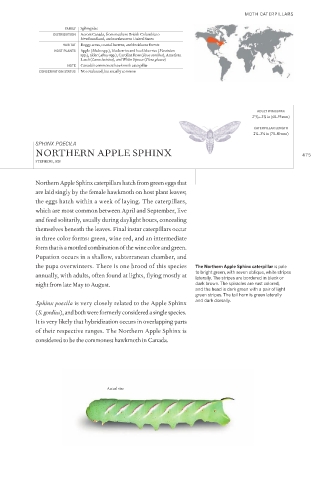
            the pupa overwinters. There is one brood of this species   The Northern Apple Sphinx caterpillar is pale
            annually, with adults, often found at lights, flying mostly at   to bright green, with seven oblique, white stripes
                                                               laterally. The stripes are bordered in black or
            night from late May to August.                     dark brown. The spiracles are rust colored,
                                                               and the head is dark green with a pair of light
                                                               green stripes. The tail horn is green laterally
            Sphinx poecila is very closely related to the Apple Sphinx   and dark dorsally.
            (S. gordius), and both were formerly considered a single species.
            It is very likely that hybridization occurs in overlapping parts
            of their respective ranges. The Northern Apple Sphinx is
            considered to be the commonest hawkmoth in Canada.


                                   Actual size

