


Page 478 - The Book of Caterpillars: A Life-Size Guide to Six Hundred Species From Around the World
P. 478
MOTH CATERPILLARS

                                                     FAMILY  Sphingidae
                                                 DISTRIBUTION  India, Sri Lanka, Nepal, Myanmar, China, Chinese Taipei,
                                                          South Korea, Japan, and Indonesia
                                                    HABITAT  Open forests, orchards, plantations, gardens, and parks
                                                  HOST PLANTS  Grapevine (Vitis spp.), arum (Amorphphallus spp.),
                                                          hibiscus (Hibiscus spp.), and treebine (Cissus spp.)

                                                      NOTE  Hawkmoth caterpillar that has in atable false eyespots
                                             CONSERVATION STATUS  Not evaluated


            ADULT WINGSPAN
           2¾–4 in (70–100 mm)
           CATERPILLAR LENGTH
           2¾–3 in (70–75 mm)                                                THERETRA CLOTHO
                                                             COMMON HUNTER
                                                                       HAWKMOTH
    476
                                                                                     (DRURY, 1773)


                                            Common Hunter Hawkmoth caterpillars hatch from pale green,
                                            smooth eggs laid singly by the female hawkmoth on host plant
                                            leaves, mostly on the underside. The larvae feed mostly by
                                            night, usually on vines cascading over walls or hanging down
                                            from trees. By day they hide within the foliage, against which
                                            they are perfectly camou aged. A further defense mechanism is

                                            their pair of false eyespots at the anterior end, which they are able
                                            to in ate when threatened. Development through  ve instars


                                            takes three to four weeks. When mature, the caterpillars crawl
                                            to the ground and form a  imsy, brown cocoon among debris.


                                            The adults, which are nocturnal or crepuscular, emerge in as
                                            little as 14 days and are on the wing from spring to fall, often
                                            producing multiple generations. The genus Theretra contains
                                            about 65 named species that occur in most parts of the world.
                                            Common Hunter Hawkmoth caterpillars consume large
                                            amounts of vegetation during development and can destroy
                                            small vines in garden settings.


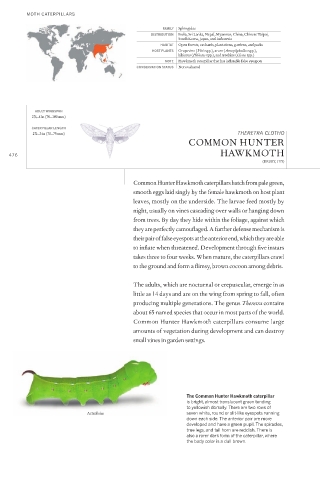
                                                             The Common Hunter Hawkmoth caterpillar
                                                             is bright, almost translucent green tending
                                                             to yellowish dorsally. There are two rows of
                             Actual size                     seven white, round or slit-like eyespots running
                                                             down each side. The anterior pair are more
                                                             developed and have a green pupil. The spiracles,
                                                             true legs, and tail horn are reddish. There is
                                                             also a rarer dark form of the caterpillar, where
                                                             the body color is a dull brown.

