


Page 485 - The Book of Caterpillars: A Life-Size Guide to Six Hundred Species From Around the World
P. 485
MOTH CATERPILLARS

                      FAMILY  Geometridae
                  DIS
                    TRIBUTION
                  DISTRIBUTION  Europe to central Asia
                  DISTRIBUTION
                     HABIT A T  Woodlands, scrub, and hedgerows
                     HABITAT
                     HABITAT
                  HOST PLANTS S  Blackthorn (Prunus spinosa)
                    T PLANT
                  HOST PLANTS
                  HOS


                      NO
                        TE
                      NOTE  Well-camou aged caterpillar that is di cult to spot
                      NOTE
                       TUS
                  A
                       A
                      T
                   TION S
             CONSERVATION STATUS
             CONSERV
             CONSERVATION STATUS  Not evaluated, but scarce in much of its range
                                                                                   ADULT WINGSPAN
                                                                                 1 ⁄   in–1¼ in (27–31 mm)
                                                                                  CATERPILLAR LENGTH
                                                                                    1 ⁄   in (30 mm)
            ALEUCIS DISTINCTATA
            SLOE CARPET                                                                          483
            (HERRICH-SCHÄFFER, [1839])
            Sloe Carpet caterpillars hatch from eggs laid on the leaves of
            the host plant and feed on the Blackthorn blossoms. The larvae
            are active until June and July, when they move to the ground
            to pupate. The caterpillars spin a cocoon among the leaf litter
            or in loose soil, and the pupae overwinter. There is a single
            generation, with the adults emerging in March and on the wing

            until April or early May, a time that coincides with the  owering
            of the Blackthorn.


            The Sloe Carpet, or Kent Mocha, as it is also known, is scarce
            across much of its range. It favors places where there are dense
            thickets of Blackthorn, such as overgrown hedgerows and
            unmanaged scrub—all areas where there are suckering young
            plants. Numbers have declined in recent decades due to changing
            countryside management. Male adults are quite similar in
            appearance to another Geometridae species, the Early Moth
            (Theria primaria), whose larvae also feed on Blackthorn.


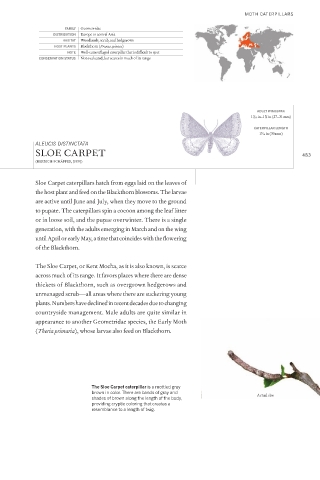
                              The Sloe Carpet caterpillar is a mottled gray
                              brown in color. There are bands of gray and          Actual size
                              shades of brown along the length of the body,
                              providing cryptic coloring that creates a
                              resemblance to a length of twig.

