


Page 483 - The Book of Caterpillars: A Life-Size Guide to Six Hundred Species From Around the World
P. 483
MOTH CATERPILLARS

                      FAMILY  Geometridae
                  DISTRIBUTION  Across Europe into central Asia
                     HABITAT  Deciduous woodland, parks, and gardens
                  HOST PLANTS  Various deciduous trees, including birch (Betula spp.) and
                           oak (Quercus spp.)

                      NOTE  Twiglike looper caterpillar that is perfectly camou aged on trees
             CONSERVATION STATUS  Not evaluated, but not considered to be at risk


                                                                                   ADULT WINGSPAN
                                                                                  1 ⁄  –1⅜ in (27–35 mm)


                                                                                  CATERPILLAR LENGTH
                                                                                  1–1 ⁄   in (25–30 mm)
            AGRIOPIS AURANTIARIA
            SCARCE UMBER                                                                         481

            (HÜBNER, [1799])


            Scarce Umber caterpillars hatch in spring from eggs that have
            overwintered on the bark of their host plants. The species is
            common and widespread with the larvae feeding on deciduous
            leaves from April to early June. The twiglike shape of the                 Actual size
            caterpillars provides them with perfect camouflage among
            the leaves and branches of the canopy. When fully fed, they
            descend from their host trees and pupate on the ground. There is
            a single generation, with the males on the wing in late fall, from
            October to November, seeking out females.


            During the day, males rest on fences and walls,  ying at night,

            when they are easily attracted to light. Scarce Umber females,
            however, are virtually wingless, having only nonfunctional,
            vestigial wings, reduced to small stubs, and spend their short
            lives crawling up and down the trunks of the host trees, where
            they lay their eggs. The caterpillars of Agriopis aurantiaria are
            easily confused with the caterpillars of a closely related species,
            the Dotted Border (A. marginaria).


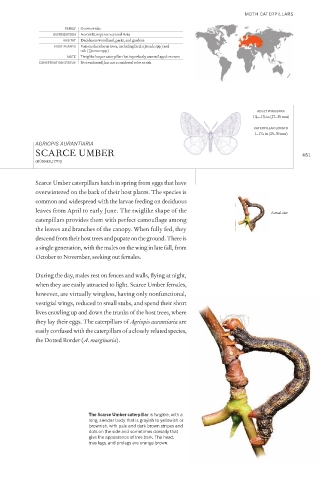
                             The Scarce Umber caterpillar is twiglike, with a
                             long, slender body that is grayish to yellowish or
                             brownish, with pale and dark brown stripes and
                             dots on the side and sometimes dorsally that
                             give the appearance of tree bark. The head,
                             true legs, and prolegs are orange brown.

