


Page 480 - The Book of Caterpillars: A Life-Size Guide to Six Hundred Species From Around the World
P. 480
MOTH CATERPILLARS

                                                     FAMILY  Sphingidae
                                                 DISTRIBUTION  Sri Lanka, India, Nepal, Bangladesh, Myanmar, Thailand, China,
                                                          Chinese Taipei, Japan, Vietnam, Malaysia, and Indonesia
                                                    HABITAT  Parks, gardens, lightly wooded areas, and waterways
                                                  HOST PLANTS  Elephant ear (Colocasia spp., Caladium spp.), water primrose
                                                          (Ludwigia spp.), rose (Rosa spp.), arum (Arum spp.), and water
                                                          caltrop (Trapa spp.)
                                                      NOTE  Fast-developing caterpillar that could become a biocontrol agent
                                             CONSERVATION STATUS  Not evaluated


            ADULT WINGSPAN
           2⅜–2  ⁄   in (60–72 mm)
           CATERPILLAR LENGTH
           2⅛–3⅛ in (55–80 mm)                                           THERETRA SILHETENSIS
                                                 BROWN-BANDED HUNTER
                                                                       HAWKMOTH
    478
                                                                                    (WALKER, 1856)


                                            Brown-banded Hunter Hawkmoth caterpillars hatch from up to
                                            150 globular, light green, smooth eggs laid singly on the upper
                                            and lower surfaces of host plant leaves by the female hawkmoth.
                                            Hatching occurs three to ten days after the eggs are laid,
                                            according to temperature. The larvae are relatively inactive,
                                            spending much of their time resting on the midrib of leaves or on
                                            small stems and feeding mainly at night. They are often heavily
                                            parasitized by braconid wasps, with up to 160 wasps developing
                                            in and emerging from a single caterpillar.


                                            Those that escape parasitization develop through  ve instars,

                                            taking two to five days per instar, and pupate in the ground
                                            about two weeks after hatching. The moths emerge from the
                                            subterranean pupae after about ten days. This species is also
                                            known as the Water Primrose Hawkmoth, and the caterpillars
                                            have been considered as a biological control agent for invasive
                                            water primrose species in Thailand. As is the case with many
                                            hawkmoth caterpillars, there are at least two color forms.


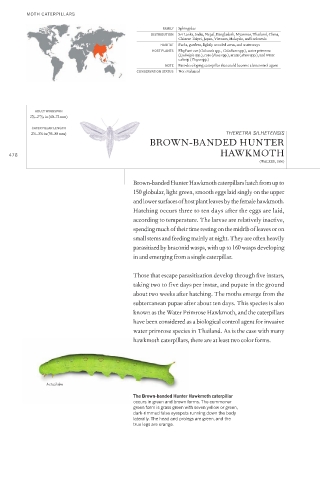
                Actual size
                                            The Brown-banded Hunter Hawkmoth caterpillar
                                            occurs in green and brown forms. The commoner
                                            green form is grass green with seven yellow or green,
                                            dark-rimmed false eyespots running down the body
                                            laterally. The head and prolegs are green, and the
                                            true legs are orange.

