


Page 481 - The Book of Caterpillars: A Life-Size Guide to Six Hundred Species From Around the World
P. 481
MOTH CATERPILLARS

                      FAMILY  Epicopeiidae
                  DIS
                  DISTRIBUTION  Northeastern India, Bhutan, and southwestern China
                    TRIBUTION
                  DISTRIBUTION
                     HABIT
                     HABITAT T  Open forests
                        A
                     HABITAT
                  HOST PLANTS
                  HOS T PLANT S  Unknown
                  HOST PLANTS
                      NO TE  Powdery, white caterpillar that feeds high in the canopy
                      NOTE
                      NOTE
                  A
                       A
                       TUS
                   TION S
                      T
             CONSERVATION STATUS
             CONSERV
             CONSERVATION STATUS  Not evaluated, but seasonally common
                                                                                   ADULT WINGSPAN
                                                                                  2 ⁄  –3 in (65–75 mm)
                                                                                  CATERPILLAR LENGTH
                                                                                    1 ⁄   in (40 mm)
            NOSSA MOOREI
            NOSSA MOOREI                                                                         479
            (ELWES, 1890)
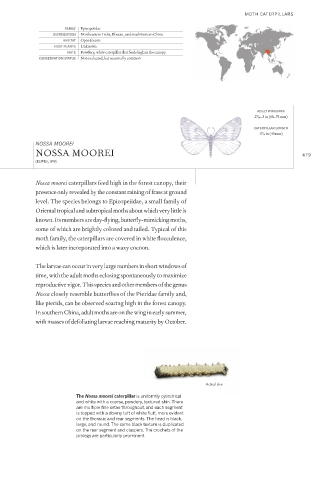
            Nossa moorei caterpillars feed high in the forest canopy, their
            presence only revealed by the constant raining of frass at ground
            level. The species belongs to Epicopeiidae, a small family of
            Oriental tropical and subtropical moths about which very little is


            known. Its members are day- ying, butter y-mimicking moths,
            some of which are brightly colored and tailed. Typical of this
            moth family, the caterpillars are covered in white  occulence,

            which is later incorporated into a waxy cocoon.

            The larvae can occur in very large numbers in short windows of
            time, with the adult moths eclosing spontaneously to maximize
            reproductive vigor. This species and other members of the genus

            Nossa closely resemble butter ies of the Pieridae family and,
            like pierids, can be observed soaring high in the forest canopy.
            In southern China, adult moths are on the wing in early summer,
            with masses of defoliating larvae reaching maturity by October.


                                                                   Actual size
                         The Nossa moorei caterpillar is uniformly cylindrical
                         and white with a coarse, powdery, textured skin. There
                         are multiple   ne setae throughout, and each segment
                         is topped with a downy tuft of white   u  , more evident
                         on the thoracic and rear segments. The head is black,
                         large, and round. The same black texture is duplicated
                         on the rear segment and claspers. The crochets of the
                         prolegs are particularly prominent.

