


Page 482 - The Book of Caterpillars: A Life-Size Guide to Six Hundred Species From Around the World
P. 482
MOTH CATERPILLARS

                                                     FAMILY  Geometridae
                                                 DISTRIBUTION  Europe, east into Siberia
                                                 DIS
                                                   TRIBUTION
                                                 DISTRIBUTION
                                                    HABITAT
                                                    HABIT A T  Lowland woodlands, hedgerows, and gardens
                                                    HABITAT
                                                  HOS
                                                  HOST PLANTS S  Varied, including Ribes spp., Prunus spp., and Crataegus spp.
                                                    T PLANT
                                                  HOST PLANTS
                                                      NO
                                                      NOTE
                                                       TE
                                                      NOTE  Distinctive caterpillar that has a black-and-white colored body
                                             CONSERVATION STATUS
                                                      TUS
                                                      A
                                                     T
                                             CONSERVATION STATUS  Not evaluated, but quite common
                                             CONSERV
                                                 A
                                                  TION S
            ADULT WINGSPAN
           1⅜–1⅞ in (35–48 mm)


           CATERPILLAR LENGTH
             1 ⁄   in (30 mm)
                                                                       ABRAXAS GROSSULARIATA
                                                                               MAGPIE
    480
                                                                                    LINNAEUS, 1758
                                            Magpie caterpillars hatch from eggs laid in late summer on the
                                            underside of leaves of the host plant. The larvae quickly seek
                                            a place to overwinter—for example, within rolled-up leaves
                                            or cracks in walls, and under bark. They emerge in spring to
                     Actual size
                                            feed on young leaves. Pupation takes place in late spring and

                                            early summer, with the caterpillars spinning a  imsy cocoon,
                                            either on or near the food plant. The adults eclose and  y in

                                            July and August.

                                            The caterpillar is a so-called looper, named for the distinctive
                                            method of moving in a looping fashion. Its conspicuous bright
                                            colors probably act as a deterrent to predators. Long considered
                                            a pest species for its defoliation of soft-fruit bushes and nut trees,
                                            its numbers have declined in recent years, possibly due to the

                                            use of pesticides. The Magpie adult is a day- ying carpet moth
                                            and—with its bright black-and-white wings— is often mistaken
                                            for a butter y.


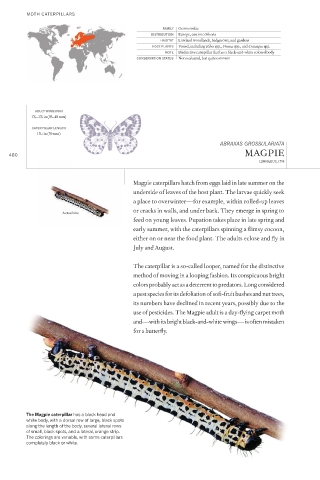
         The Magpie caterpillar has a black head and
         white body, with a dorsal row of large, black spots
         along the length of the body, several lateral rows
         of small, black spots, and a lateral, orange strip.
         The colorings are variable, with some caterpillars
         completely black or white.

