


Page 484 - The Book of Caterpillars: A Life-Size Guide to Six Hundred Species From Around the World
P. 484
MOTH CATERPILLARS

                                                     FAMILY  Geometridae
                                                 DISTRIBUTION  Across Europe, east to the Urals
                                                    HABITAT  Woodlands, heaths, parks, and gardens
                                                  HOST PLANTS  Deciduous trees, including alder (Alnus spp.), beech (Fagus spp.),
                                                          and oak (Quercus spp.)

                                                      NOTE  Well-camou aged caterpillar that feeds on deciduous leaves
                                             CONSERVATION STATUS  Not evaluated, but quite common


            ADULT WINGSPAN
           1 ⁄  –1¼ in (27–32 mm)
           CATERPILLAR LENGTH
             1 ⁄   in (30 mm)
                                                                          AGRIOPIS MARGINARIA
                                                               DOTTED BORDER
    482
                                                                                   (FABRICIUS, 1777)


                                            Dotted Border caterpillars hatch from small, oval, green eggs
                                            laid on the tree trunks of their host species. Their defense is
                                            their realistically twiglike appearance. They are present from

                                            April to June but largely unseen as they remain camou aged in
                                            the tree canopy, where they feed mostly on young leaves. In the
                                             nal instar, when fully fed, the larvae descend to the ground to

                                            pupate and overwinter under the soil as a pupa. There is a single
                                            generation, with adults eclosing early the following year, from
                                            February to April, although occasionally as early as January
                                            and as late as May.


                                            Agriopis marginaria males are night- ying and attracted to light.
                                            Females, however, like those of the closely related species Scarce
                                            Umber (A. aurantiaria), are  ightless, with only tiny vestigial

                                            wings, and are found resting on tree trunks, where they lay
                                            their eggs. The young caterpillars are easily confused with
                                            A. aurantiaria larvae, which feed on the same host trees. The
                                            Dotted Border is common across much of its range, occurring
                                            in a wide range of habitats, due to the widespread distribution
                                            of the host plants.


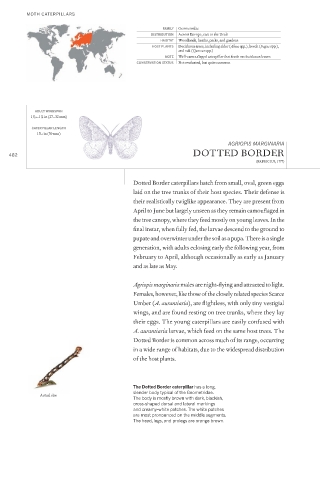
                                            The Dotted Border caterpillar has a long,
                                            slender body typical of the Geometridae.
              Actual size
                                            The body is mostly brown with dark, blackish,
                                            cross-shaped dorsal and lateral markings
                                            and creamy-white patches. The white patches
                                            are most pronounced on the middle segments.
                                            The head, legs, and prolegs are orange brown.

