


Page 497 - The Book of Caterpillars: A Life-Size Guide to Six Hundred Species From Around the World
P. 497
MOTH CATERPILLARS

                      FAMILY  Geometridae
                  DISTRIBUTION  North America, from Saskatchewan east to Nova Scotia,
                           south to Florida, and west to Texas
                     HABITAT  Deciduous and mixed woodlands
                  HOST PLANTS  Ash (Fraxinus spp.), basswood (Tilia spp.), birch (Betula spp.),
                           elm (Ulmus spp.), poplar (Populus spp.), willow (Salix spp.),
                           maple (Acer spp.), and other trees
                      NOTE  Twig-mimicking caterpillar
             CONSERVATION STATUS  Not evaluated, but common


                                                                                   ADULT WINGSPAN
                                                                                  1½–2 ⁄   in (38–56 mm)
                                                                                  CATERPILLAR LENGTH
            EUTRAPELA CLEMATARIA                                                    2⅜ in (60 mm)
            CURVED-TOOTHED
            GEOMETER                                                                             495

            (J. E. SMITH, 1797)


            Curved-toothed Geometer caterpillars emerge from eggs that
            are green when laid and turn red just before hatching. The
            young larvae have a dark brown body, while the older larvae
            have a greenish, tan, gray, or dark purplish-brown body, helping
            them to blend in with their host tree. It takes about 40 days for

            the caterpillar to develop. Adult moths  y from March to August
            in most of the range but can be found year-round in the south.
            There are two generations a year.


            While not widely known as a pest, Eutrapela clemataria has
            been reported as extremely destructive in small areas of bogs

            where cranberries are grown, the larvae eating  ower buds and
            blossoms and so adversely affecting production of the fruit.
            The caterpillars of this species, like many others, su er from

            ant predation, although a study examining E. clemataria and
            other moth caterpillars showed that the risk of such predation
            was less when the range of host plants was increased. The species
            is the only member of the genus Eutrapela.


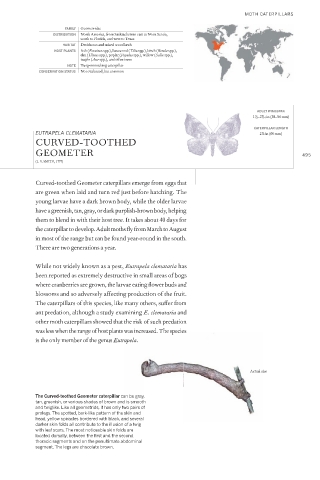
                                                                                 Actual size


            The Curved-toothed Geometer caterpillar can be gray,
            tan, greenish, or various shades of brown and is smooth
            and twiglike. Like all geometrids, it has only two pairs of
            prolegs. The spotted, bark-like pattern of the skin and
            head, yellow spiracles bordered with black, and several
            darker skin folds all contribute to the illusion of a twig
            with leaf scars. The most noticeable skin folds are
            located dorsally, between the   rst and the second
            thoracic segments and on the penultimate abdominal
            segment. The legs are chocolate brown.

