


Page 498 - The Book of Caterpillars: A Life-Size Guide to Six Hundred Species From Around the World
P. 498
MOTH CATERPILLARS

                                                     FAMILY  Geometridae
                                                 DISTRIBUTION  Europe and across Asia to China and Japan
                                                    HABITAT  Woodlands, scrub, heathlands, and wet woodlands near streams
                                                  HOST PLANTS  Mostly birch (Betula spp.), but also Alder (Alnus glutinosa), beech
                                                          (Fagus spp.), and hazel (Corylus avellana)
                                                      NOTE  Green looper caterpillar that is found on a variety of food plants
                                             CONSERVATION STATUS  Not evaluated


            ADULT WINGSPAN
           2–2 ⁄   in (50–65 mm)
           CATERPILLAR LENGTH


           1 ⁄  –1⅜ in (30–35 mm)
                                                                        GEOMETRA PAPILIONARIA
                                                                LARGE EMERALD
    496
                                                                                    LINNAEUS, 1758


                                            Large Emerald caterpillars hatch from eggs laid in late summer.

                                            The young larvae are green at  rst but soon become pale brown
                                            with warts, giving them a twiglike appearance. This provides

                                            much better camou age for when they overwinter on dormant
                                            trees. The caterpillars are active again in spring, when they
                                            become greener in color once more to blend in with the new
                                            spring growth of leaves. When fully developed, the larvae move
                                            to the ground to pupate in a cocoon among the leaf litter.


                                            The caterpillar is a so-called “looper,” moving along branches
                                            by drawing its rear end up to the thorax, extending the head
                                            and thorax forward until it lies flat, and then repeating the


                                            movement. The large, night- ying moth adult is butter y-like
                                            with bright green wings that fade with age. The species occurs
                                            in a wide range of habitats, as the caterpillar feeds on many
                                            di erent plants, although its preference is for birch.


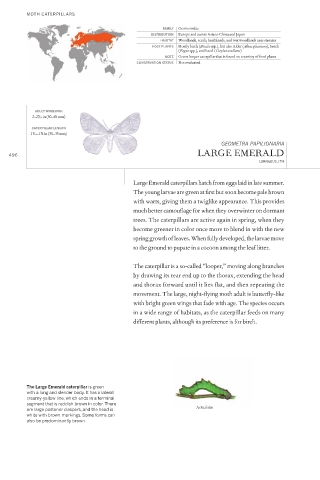
          The Large Emerald caterpillar is green
          with a long and slender body. It has a lateral
          creamy-yellow line, which ends in a terminal
          segment that is reddish brown in color. There
          are large posterior claspers, and the head is         Actual size
          white with brown markings. Some forms can
          also be predominantly brown.

