


Page 499 - The Book of Caterpillars: A Life-Size Guide to Six Hundred Species From Around the World
P. 499
MOTH CATERPILLARS

                      FAMILY  Geometridae
                  DISTRIBUTION  Europe, North Africa, and through central Asia to
                           southern Siberia
                     HABITAT  Scrub, waste ground, verges, parks, and gardens
                  HOST PLANTS  Mallow (Malva sylvestris) and related species, such as
                           Althaea o   cinalis and Bristly Hollyhock (Alcea setosa)
                      NOTE  Caterpillar that raises its body to resemble a twig
             CONSERVATION STATUS  Not evaluated, but locally rare


                                                                                   ADULT WINGSPAN
                                                                                  1 ⁄  –1 ⁄   in (36–40 mm)
                                                                                  CATERPILLAR LENGTH
                                                                                    1 ⁄   in (40 mm)
            LARENTIA CLAVARIA
            MALLOW                                                                               497

            (HAWORTH, 1809)


            Eggs laid on the food plants by the night- ying female Mallow
            moths overwinter, and the larvae hatch the following spring.
            When not feeding, the caterpillar rests on the upper surface

            of leaves and holds on  rmly with its terminal claspers, raising
            the rest of the body to give the appearance of a green twig. This
            makes the larva very di cult to spot and reduces predation.


            The caterpillars are active from April to July, moving from their

            host plant to the ground to pupate. The night- ying moths are
            on the wing from August to November.

            Like other members of the Geometridae, the caterpillars
            are loopers. Their prolegs are found toward the end of the
            abdomen, giving the caterpillars their characteristic looping
            movement. There are several subspecies across the range. The
            dependence of Larentia clavaria on a limited range of food plants
            has contributed to a decline in its numbers, and the moth is now
            classed as rare in some parts of its range.


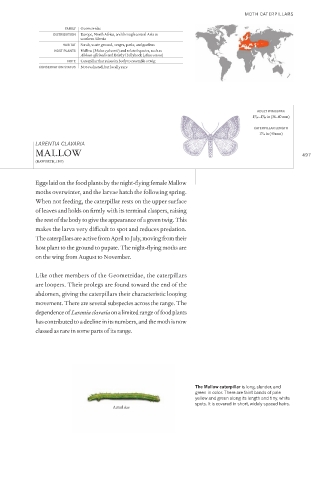
                                                               The Mallow caterpillar is long, slender, and
                                                               green in color. There are faint bands of pale
                                                               yellow and green along its length and tiny, white
                                                               spots. It is covered in short, widely spaced hairs.
                                     Actual size

