


Page 500 - The Book of Caterpillars: A Life-Size Guide to Six Hundred Species From Around the World
P. 500
MOTH CATERPILLARS

                                                     FAMILY  Geometridae
                                                 DISTRIBUTION  United States, from South Dakota in the Midwest south to Texas,
                                                          and from Massachusetts to Florida in the east
                                                    HABITAT  Pitch pine-scrub oak barrens in the north; woodlands and
                                                          forests in the south
                                                  HOST PLANTS  Apple (Malus spp.), Clethra spp., Myrica spp., cherry (Prunus spp.),
                                                          oak (Quercus spp.), Vaccinium spp., and likely many other
                                                          woody plants
                                                      NOTE  Caterpillar that is colorful and variable; adult females are wingless
                                             CONSERVATION STATUS  Not evaluated, but relatively common in the south of its range
                                                          and rare in the north


            ADULT WINGSPAN
           1⅛–1⅝ in (29–41 mm)
           CATERPILLAR LENGTH
             1 ⁄   in (40 mm)
                                                                                LYCIA YPSILON
                                                                   WOOLLY GRAY
    498
                                                                                    (FORBES, 1885)


                                            Woolly Gray caterpillars hatch in spring and feed on a variety
                                            of woody plants. While most geometrid caterpillars are
                                            cryptically colored in subdued gray, brown, or green, this
                                            species is brightly colored and patterned, though not aposematic.
                                            It seems most likely that the markings serve a dual purpose;
                                            their complexity and variability help the caterpillars evade
                                            birds, which are skillful at recognizing only speci c patterns,

                                            and, if the larvae are detected, their bright coloring might also
                                            alarm potential predators.


                                            Lycia ypsilon overwinters as a pupa, and, in the north of its range,
                                            the males eclose and  y before all the snow has melted. In the

                                            south of its range (Florida), it is also one of the earliest moths of

                                            the year,  ying from January to March in a single generation.
                                            The females are wingless and crawl on the ground, making
                                            them hardly recognizable as Lepidoptera.


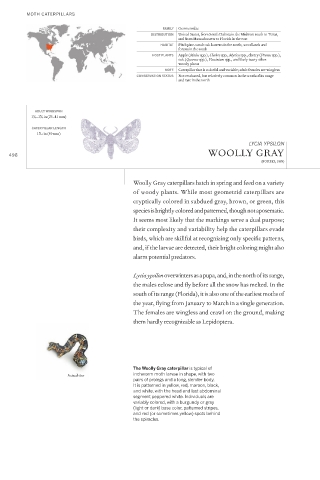
                                            The Woolly Gray caterpillar is typical of
                       Actual size          inchworm moth larvae in shape, with two
                                            pairs of prolegs and a long, slender body.
                                            It is patterned in yellow, red, maroon, black,
                                            and white, with the head and last abdominal
                                            segment peppered white. Individuals are
                                            variably colored, with a burgundy or gray
                                            (light or dark) base color, patterned stripes,
                                            and red (or sometimes yellow) spots behind
                                            the spiracles.

