


Page 501 - The Book of Caterpillars: A Life-Size Guide to Six Hundred Species From Around the World
P. 501
MOTH CATERPILLARS

                      FAMILY  Geometridae
                  DISTRIBUTION  Across southern Canada, from Vancouver Island to Nova Scotia,
                           south to much of the United States, excluding California
                     HABITAT  Deciduous and mixed wood forests and woodlands
                  HOST PLANTS  Douglas Fir (Pseudotsuga menziesii), willow (Salix spp.),
                           White Birch (Betula papyrifera), hazelnut (Corylus spp.), and
                           others; occasionally on crops such as strawberries (Fragaria spp.)
                           and carrots (Daucus spp.)

                      NOTE  Caterpillar that has two pairs of long  laments, or tentacles
             CONSERVATION STATUS  Not evaluated, but common in riparian habitats in parts of
                           its range


                                                                                   ADULT WINGSPAN
                                                                                   ¾–1 in (20–25 mm)
                                                                                  CATERPILLAR LENGTH
                                                                                  1½–2 in (38–51 mm)
            NEMATOCAMPA RESISTARIA
            HORNED SPANWORM                                                                      499

            HERRICH-SCHÄFFER, [1856]


            The Horned Spanworm, also called the Filament Bearer, is
            named for its unusual caterpillar, which bears  laments on three


            of the abdominal segments. The  laments are initially short but
            increase in length as the caterpillar grows. Their function is
            not clear, but the sensory hairs on them suggest that they may,
            for instance, help the larva to detect vibrations produced by an
            approaching predator. Alerted, the caterpillar would then stop


            moving; at rest, it is well camou aged as the  laments provide
            additional structures that make it look much like a twig.

            The moth is also cryptically colored, with colors and a pattern
            that make it practically invisible against a background of
            fallen leaves. As a member of the inchworm moth family,
            Geometridae, which are mostly cryptically colored and
            palatable, Nematocampa resistaria is an essential part of the food
            chain: birds feed on Geometrids, and especially during colder
            months, when other insects are less abundant, this moth becomes
            an important food source.


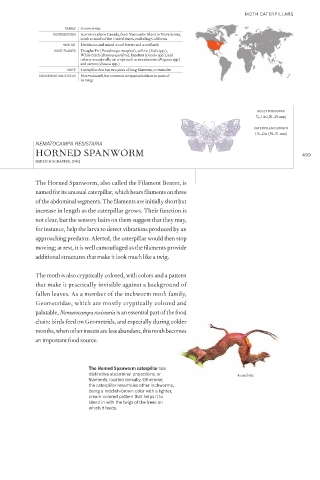
                             The Horned Spanworm caterpillar has
                             distinctive abdominal projections, or           Actual size
                               laments, located dorsally. Otherwise,
                             the caterpillar resembles other inchworms,
                             being a reddish-brown color with a lighter,
                             cream-colored pattern that helps it to
                             blend in with the twigs of the trees on
                             which it feeds.

