


Page 503 - The Book of Caterpillars: A Life-Size Guide to Six Hundred Species From Around the World
P. 503
MOTH CATERPILLARS

                      FAMILY  Geometridae
                  DISTRIBUTION  Europe and across Asia to China and Japan
                     HABITAT  Scrub, waste ground, verges, and gardens
                  HOST PLANTS  Orache (Atriplex spp.) and goosefoot (Chenopodium spp.)

                      NOTE  Odd-looking caterpillar that has perfect camou age
             CONSERVATION STATUS  Not evaluated, but locally rare


                                                                                   ADULT WINGSPAN
                                                                                  1–1 ⁄   in (25–30 mm)
                                                                                  CATERPILLAR LENGTH
                                                                                    ¾ in (20 mm)
            PELURGA COMITATA
            DARK SPINACH                                                                         501

            (LINNAEUS, 1758)


            Dark Spinach caterpillars hatch from clusters of small, creamy-
            colored eggs laid on the leaves of the host plants. The larvae are
            active in August and September, feeding on their weedy orache
            and goosefoot host plants, preferring  owers and seeds to the

            leaves. The caterpillars move along branches in the looping style
            typical of the family. The species overwinters underground as   Actual size
            a pupa, which is red brown in color. The adult moths are on the
            wing in July and August, and there is a single generation.


            The moths favor weedy ground, such as derelict land, verges,
            and gardens. However, numbers of this species have fallen
            steeply in recent decades as the increased use of weed killers on
            farmland and general loss of derelict land has killed o  many

            of their host plants. For example, in the United Kingdom, the
            Pelurga comitata population reportedly declined by 89 percent
            between 1968 and 2002, and it is now classed as a priority species.


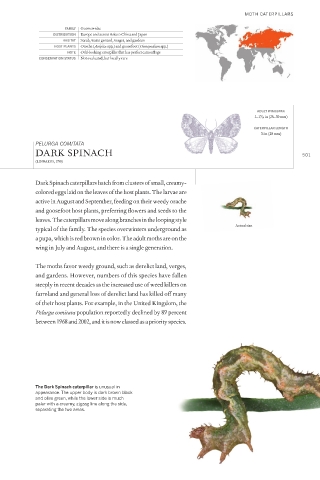
            The Dark Spinach caterpillar is unusual in
            appearance. The upper body is dark brown black
            and olive green, while the lower side is much
            paler with a creamy, zigzag line along the side,
            separating the two areas.

