


Page 504 - The Book of Caterpillars: A Life-Size Guide to Six Hundred Species From Around the World
P. 504
MOTH CATERPILLARS

                                                     FAMILY  Geometridae
                                                 DISTRIBUTION  Europe and across Asia to Japan
                                                    HABITAT  Deciduous woodlands
                                                  HOST PLANTS  Deciduous trees, including birch (Betula spp.),
                                                          oak (Quercus spp.), and willow (Salix spp.)
                                                      NOTE  Caterpillar whose twiglike appearance provides
                                                          perfect camou age

                                             CONSERVATION STATUS  Not evaluated


            ADULT WINGSPAN
           1⅛–1¼ in (28–32 mm)
           CATERPILLAR LENGTH
             1 ⁄   in (30 mm)
                                                                         PLAGODIS DOLABRARIA
                                                               SCORCHED WING
    502
                                                                                   (LINNAEUS, 1767)


                                            Scorched Wing caterpillars hatch from oval, white eggs laid
                                            along leaf margins, and they can be seen in woodlands from
                                            May to October. To escape predation, the caterpillar relies

                                            on camou age, gripping a twig with its terminal claspers and
                                            raising its body up so that it looks like a short length of twig.
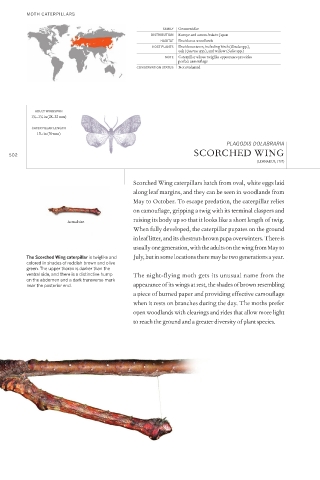
                       Actual size
                                            When fully developed, the caterpillar pupates on the ground
                                            in leaf litter, and its chestnut-brown pupa overwinters. There is
                                            usually one generation, with the adults on the wing from May to

         The Scorched Wing caterpillar is twiglike and   July, but in some locations there may be two generations a year.
         colored in shades of reddish brown and olive
         green. The upper thorax is darker than the
         ventral side, and there is a distinctive hump   The night-flying moth gets its unusual name from the
         on the abdomen and a dark transverse mark
         near the posterior end.            appearance of its wings at rest, the shades of brown resembling
                                            a piece of burned paper and providing effective camouflage
                                            when it rests on branches during the day. The moths prefer
                                            open woodlands with clearings and rides that allow more light
                                            to reach the ground and a greater diversity of plant species.

