


Page 505 - The Book of Caterpillars: A Life-Size Guide to Six Hundred Species From Around the World
P. 505
MOTH CATERPILLARS

                      FAMILY  Geometridae
                  DISTRIBUTION  Europe, except Iberia and Greece, into central Asia and Siberia
                     HABITAT  Woodlands, hedgerows, parks, and gardens
                  HOST PLANTS  Various deciduous trees, including birch (Betula spp.) and
                           oak (Quercus spp.)

                      NOTE  Well-camou aged, twiglike caterpillar
             CONSERVATION STATUS  Not evaluated


                                                                                   ADULT WINGSPAN
                                                                                  1½–1¾ in (38–44 mm)
                                                                                  CATERPILLAR LENGTH
                                                                                   ¾–1 in (20–25 mm)
            SELENIA LUNULARIA
            LUNAR THORN                                                                          503

            (HÜBNER, 1788)


            Lunar Thorn caterpillars hatch from small, round, red-colored
            eggs laid on a large range of trees and shrubs on which the larvae
            feed. They pupate on the plant, attaching to the underside of
            leaves and branches. The pupa is bright green. There are two
            generations annually, one in June and another in August and     Actual size
            September. The pupa of the second generation overwinters, and
            the adults emerge in late spring. The moths are on the wing from
            May to August.

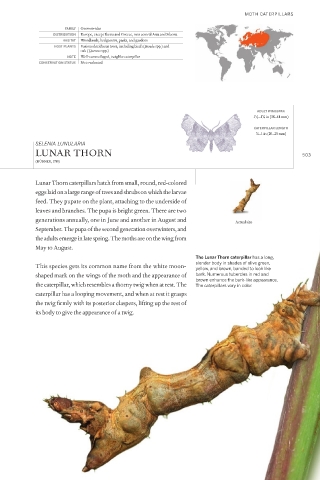
                                                               The Lunar Thorn caterpillar has a long,
            This species gets its common name from the white moon-  slender body in shades of olive green,
                                                               yellow, and brown, banded to look like
            shaped mark on the wings of the moth and the appearance of   bark. Numerous tubercles in red and
            the caterpillar, which resembles a thorny twig when at rest. The   brown enhance the bark-like appearance.
                                                               The caterpillars vary in color.
            caterpillar has a looping movement, and when at rest it grasps

            the twig  rmly with its posterior claspers, lifting up the rest of
            its body to give the appearance of a twig.

