


Page 506 - The Book of Caterpillars: A Life-Size Guide to Six Hundred Species From Around the World
P. 506
MOTH CATERPILLARS

                                                     FAMILY  Geometridae
                                                 DISTRIBUTION  Widespread in North America, from southern Canada to Georgia,
                                                          with highest concentrations in the Piedmont plateau region in
                                                          eastern United States

                                                    HABITAT  Flowering  elds and gardens
                                                  HOST PLANTS  Aster spp., black-eyed susan (Rudbeckia spp.), snakeroot
                                                          (Ageratina spp.), goldenrod (Solidago spp.), and other
                                                           owering plants


                                                      NOTE  Covert, camou aged caterpillar
                                             CONSERVATION STATUS  Not evaluated, but not threatened


            ADULT WINGSPAN
               ⁄   in (17 mm)
           CATERPILLAR LENGTH
              ⁄   in (15 mm)
                                                                            SYNCHLORA AERATA
                                                    CAMOUFLAGED LOOPER
    504
                                                                                   (FABRICIUS, 1798)


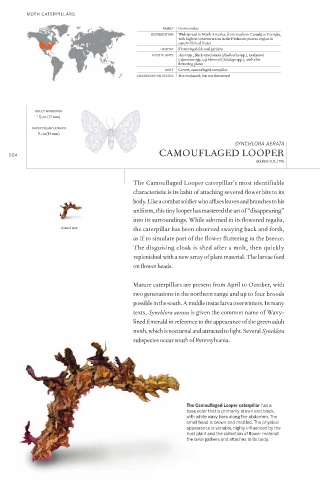
                                            The Camouflaged Looper caterpillar’s most identifiable
                                            characteristic is its habit of attaching severed  ower bits to its

                                            body. Like a combat soldier who a xes leaves and branches to his


                                            uniform, this tiny looper has mastered the art of “disappearing”
                                            into its surroundings. While adorned in its  owered regalia,

                    Actual size             the caterpillar has been observed swaying back and forth,
                                            as if to simulate part of the flower fluttering in the breeze.
                                            The disguising cloak is shed after a molt, then quickly
                                            replenished with a new array of plant material. The larvae feed

                                            on  ower heads.

                                            Mature caterpillars are present from April to October, with
                                            two generations in the northern range and up to four broods
                                            possible in the south. A middle instar larva overwinters. In many
                                            texts, Synchlora aerata is given the common name of Wavy-
                                            lined Emerald in reference to the appearance of the green adult
                                            moth, which is nocturnal and attracted to light. Several Synchlora
                                            subspecies occur south of Pennsylvania.


                                                             The Camou aged Looper caterpillar has a
                                                             base color that is primarily brown and black,
                                                             with white wavy lines along the abdomen. The
                                                             small head is brown and mottled. The physical
                                                             appearance is variable, highly in  uenced by the
                                                             host plant and the collection of   ower material
                                                             the larva gathers and attaches to its body.

