


Page 507 - The Book of Caterpillars: A Life-Size Guide to Six Hundred Species From Around the World
P. 507
MOTH CATERPILLARS

                      FAMILY  Geometridae
                  DISTRIBUTION  Northeast Himalayas, southern China, Chinese Taipei,
                           and Southeast Asia to Borneo
                     HABITAT  Montane forests
                  HOST PLANTS  Oak (Quercus spp.)
                      NOTE  Caterpillar that precisely mimics fresh host plant growth
             CONSERVATION STATUS  Not evaluated, but not uncommon


                                                                                   ADULT WINGSPAN
                                                                                  2–2¾ in (50–70 mm)
                                                                                  CATERPILLAR LENGTH
            TANAORHINUS VIRIDILUTEATUS                                              1 ⁄   in (40 mm)
            TANAORHINUS
            VIRIDILUTEATUS                                                                       505

            (WALKER, 1861)


            The Tanaorhinus viridiluteatus caterpillar is typical of geometrid
            looper or inchworm moths. It has well-developed anal claspers
            but only one pair of prolegs and a limbless gap between the true
            legs and prolegs, which means it moves in a looping fashion.
            At rest, however, the larva will usually secure itself to the host
            plant using the rear limbs only and levitate the rest of the body in
            an arch. The caterpillars feed at the extremes of branchlets, often
            completely consuming entire leaves and resting inconspicuously
            at the base of the naked petioles and stipules. Pupation occurs
            within a light, silken cocoon in a folded host plant leaf.


            Both caterpillar and adult moth are masterfully camou aged.

            The abdominal segments of the caterpillar possess hornlike
            growths resembling leaf stipules and new leaf buds. These
            lengthen as the caterpillar matures. Body markings also become

            woodier in appearance with maturity to re ect the graduation to
            more substantial and developed foliage. The moth is leaf green,
            with subtle markings resembling anomalies on a leaf ’s surface.


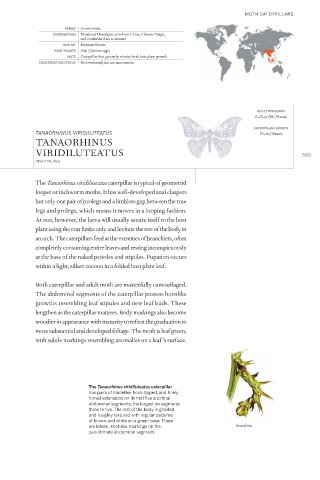
                             The Tanaorhinus viridiluteatus caterpillar
                             has pairs of bladelike, hook-tipped, and   nely
                             furred extensions on its   rst   ve and   nal
                             abdominal segments, the largest on segments
                             three to   ve. The rest of the body is gnarled
                             and roughly textured with regular patterns
                             of brown and white on a green base. There
                             are lateral, knot-like markings on the         Actual size
                             penultimate abdominal segment.

