


Page 509 - The Book of Caterpillars: A Life-Size Guide to Six Hundred Species From Around the World
P. 509
MOTH CATERPILLARS

                      FAMILY  Notodontidae
                  DISTRIBUTION  Europe and across Asia to Japan
                     HABITAT  Wet, lowland forests
                  HOST PLANTS  Birch (Betula spp.), poplar (Populus spp.), and willow (Salix spp.)
                      NOTE  Caterpillar that rears up and looks larger when threatened
             CONSERVATION STATUS  Not evaluated, but locally rare


                                                                                   ADULT WINGSPAN


                                                                                  1–1⅜ in (25–35 mm)
                                                                                  CATERPILLAR LENGTH
                                                                                    1 ⁄   in (40 mm)
            CERURA ERMINEA
            LESSER PUSS MOTH                                                                     507

            ESPER, 1783


            Lesser Puss Moth caterpillars hatch from reddish-brown,

             attened eggs laid on the underside of leaves of the food plant.
            Usually, the larvae remain high in the tree canopy as they
            develop. When disturbed, the caterpillar acts defensively by
            rearing up to look larger. It overwinters as a pupa, protected
            within a tough cocoon made from wood shavings. The adults
            are on the wing from May to July, with the caterpillars seen from
            June to August.


            The Cerura erminea caterpillar is very similar in appearance to its
            close relative the Puss Moth (C. vinula) but lacks the red collar
            and false eyes of the Puss Moth larva and also has a vertical
            white mark halfway along the abdomen. Once more common,

            the Lesser Puss Moth is su ering from the loss of lowland forests
            rich in native black poplar trees. As a result, the species is often
            classed as scarce or rare within its range.


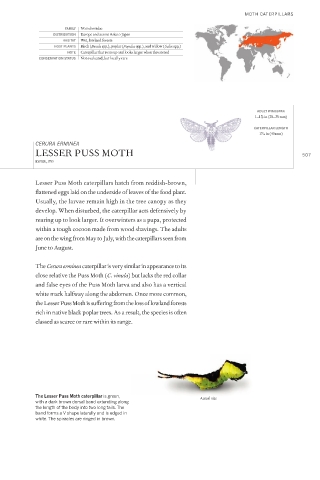
            The Lesser Puss Moth caterpillar is green,           Actual size
            with a dark brown dorsal band extending along
            the length of the body into two long tails. The
            band forms a V shape laterally and is edged in
            white. The spiracles are ringed in brown.

