


Page 508 - The Book of Caterpillars: A Life-Size Guide to Six Hundred Species From Around the World
P. 508
MOTH CATERPILLARS

                                                     FAMILY  Geometridae
                                                 DISTRIBUTION  Across northern Europe into western Siberia
                                                    HABITAT  Woodlands, woodland margins, grasslands, bogs, and uplands
                                                  HOST PLANTS  Low-growing plants such as bedstraw (Galium spp.), knotgrass
                                                          (Polygonium spp.), and Vaccinium spp.

                                                      NOTE  Camou aged, twiglike caterpillar that has a looping movement
                                             CONSERVATION STATUS  Not evaluated


            ADULT WINGSPAN

           ¾–1⅓  in (20–26 mm)

           CATERPILLAR LENGTH
           1–1 ⁄   in (25–30 mm)
                                                                      XANTHORHOE SPADICEARIA
                                                   RED TWIN-SPOT CARPET
    506
                                                                          (DENIS & SCHIFFERMÜLLER, 1775)


                                            The caterpillars of the Red Twin-spot Carpet moth hatch from
                                            creamy-yellow, oval eggs laid on the underside of leaves either
                                            singly or in small clusters. The larvae, which mature quite
                                            quickly, feed on leaves and then crawl to the ground to pupate,
                                            where they spin a silky cocoon among the leaf litter. The pupa
                                            is red brown in color.

                                            The moths may be seen during the day but are most active
                                            at dusk. There are usually two generations a year, with the
                                            moths on the wing from early May to June and July to August.
                                            The pupae of the second generation overwinter. In the more

                                            northerly parts of the range, there is a single generation  ying
                                            from June to July. The adult moth, which has two dark spots
                                            close to the outer edge of each forewing, is very similar in
                                            appearance to the closely related Dark-barred Twin-spot Carpet
                                            (Xanthorhoe ferrugata).


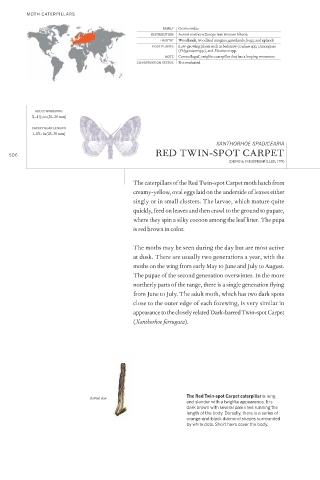
                              Actual size                    The Red Twin-spot Carpet caterpillar is long
                                                             and slender with a twiglike appearance. It is
                                                             dark brown with several pale lines running the
                                                             length of the body. Dorsally, there is a series of
                                                             orange-and-black diamond shapes surrounded
                                                             by white dots. Short hairs cover the body.

