


Page 510 - The Book of Caterpillars: A Life-Size Guide to Six Hundred Species From Around the World
P. 510
MOTH CATERPILLARS

                                                     FAMILY  Notodontidae
                                                 DISTRIBUTION  Southern Canada, from eastern Alberta east to Quebec,
                                                          south through United States to Florida, and west to Texas
                                                    HABITAT  Deciduous woodlands near rivers and lakes
                                                  HOST PLANTS  Cherry (Prunus spp.), poplar (Populus spp.), and willow
                                                          (Salix spp.)

                                                      NOTE  Caterpillar defended by face-like pattern,  agella, and
                                                          formic acid
                                             CONSERVATION STATUS  Not evaluated


            ADULT WINGSPAN
           1–1 ⁄   in (25–40 mm)
           CATERPILLAR LENGTH
           2–2⅜ in (50–60 mm)
                                                                          CERURA SCITISCRIPTA
                                             BLACK-ETCHED PROMINENT
    508
                                                                                     WALKER, 1865


                                            Black-etched Prominent caterpillars, like other related
                                            prominents, hatch from eggs laid on the underside of host plant
                                            leaves and may initially feed together. When resting, the larvae
                                            are quite cryptic, but, like other members of their genus, it is their
                                            appearance when threatened that has gained them notoriety.
                                            As they raise and retract their head to face an opponent, the
                                            thoracic region swells, exposing and emphasizing the red
                                            coloration and two black eyespots, so that the caterpillar
                                            resembles a face with an open mouth. Simultaneously, it raises
                                            its “tail”—black flagella equipped with bright orange-red
                                            extensions—and may also squirt formic acid.


                                            While such defenses will not deter a predating Blackbird (Turdus

                                            merula) or Praying Mantis (Mantis religiosa), they seem e ective
                                            against some parasitoids such as Cotesia wasps, which are
                                            possibly repelled by scents stored in the  agella. Nevertheless,

                                            these larvae are not completely immune to parasitism. Mature
                                            caterpillars pupate on a leaf or stem in a cocoon of silk and plant
                                            tissue, and the adults  y from March to October in one or two

                                            generations depending on location. The genus Cerura comprises
                                            20 species of moths that all have striking larvae.


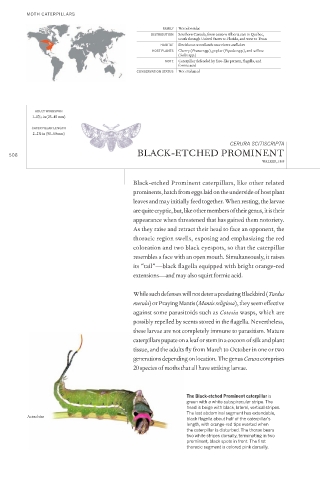
                                                             The Black-etched Prominent caterpillar is
                                                             green with a white subspiracular stripe. The
                                                             head is beige with black, lateral, vertical stripes.
                                                             The last abdominal segment has extendable,
          Actual size
                                                             black   agella about half of the caterpillar’s
                                                             length, with orange-red tips everted when
                                                             the caterpillar is disturbed. The thorax bears
                                                             two white stripes dorsally, terminating in two
                                                             prominent, black spots in front. The   rst
                                                             thoracic segment is colored pink dorsally.

