


Page 512 - The Book of Caterpillars: A Life-Size Guide to Six Hundred Species From Around the World
P. 512
MOTH CATERPILLARS

                                                     FAMILY  Notodontidae
                                                   TRIBUTION
                                                 DIS
                                                 DISTRIBUTION  Europe and across Asia to China, Korea, and Japan
                                                 DISTRIBUTION
                                                    HABITAT T  Wet woodlands; only shingle banks in United Kingdom
                                                       A
                                                    HABITAT
                                                    HABIT
                                                  HOS T PLANT S  Poplar (Populus spp.) and willow (Salix spp.)
                                                  HOST PLANTS
                                                  HOST PLANTS
                                                      NO TE  Hairy caterpillar that has rows of black and orange spots
                                                      NOTE
                                                      NOTE
                                             CONSERV A TION S T A TUS  Not evaluated, but scarce or rare in parts of its range
                                             CONSERVATION STATUS
                                             CONSERVATION STATUS
            ADULT WINGSPAN
             1 ⁄   in (37 mm)
           CATERPILLAR LENGTH
             1 ⁄   in (30 mm)
                                                                         CLOSTERA ANACHORETA
                                                  SCARCE CHOCOLATE-TIP
    510
                                                                          (DENIS & SCHIFFERMÜLLER, 1775)


                                            Female Scarce Chocolate-tip moths lay their slightly  attened

                                            eggs on the underside of leaves of the host plant. The young
                                            caterpillars emerge within a few days and feed on the host plant
                                            leaves. When fully grown, they pupate in a loose silken cocoon
                                            within a rolled-up leaf. The second generation of adult moths
                                            emerges three to four weeks later. The caterpillars of the second
                                            generation are active until September and then pupate. These
                                            pupae overwinter, and the adults emerge in spring. There are

                                            usually two generations a year, with adults  ying in April to May
                                            and again in July and August.


                                            This species is rare in the United Kingdom and at risk across some
                                            its range due to the loss of suitable habitats and because it has a
                                            narrow range of host plants. In the past, poplars were common in
                                            the landscape of Europe but are now planted less frequently.
                                            The moth is similar to the more widespread Chocolate-tip
                                            (Clostera curtula) but distinguished by a white line on its
                                            chocolate-colored wingtips.


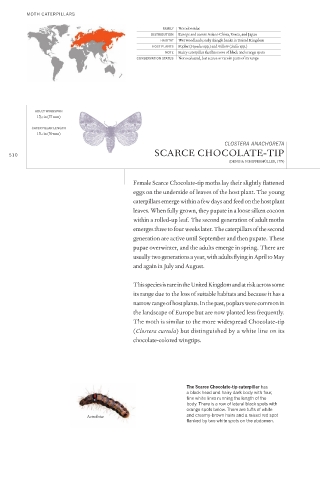
                                                             The Scarce Chocolate-tip caterpillar has
                                                             a black head and hairy dark body with four,
                                                               ne white lines running the length of the
                                                             body. There is a row of lateral black spots with
                                                             orange spots below. There are tufts of white
                             Actual size                     and creamy-brown hairs and a raised red spot
                                                               anked by two white spots on the abdomen.

