


Page 570 - The Book of Caterpillars: A Life-Size Guide to Six Hundred Species From Around the World
P. 570
MOTH CATERPILLARS

                                                     FAMILY  Erebidae
                                                 DISTRIBUTION  Southern Canada and eastern United States, with occasional
                                                          outbreaks in the west; also Europe, North Africa, and Asia
                                                    HABITAT  Temperate forests
                                                  HOST PLANTS  More than 500 coniferous and broadleaved tree species, including
                                                          oak (Quercus spp.), willow (Salix spp.), and birch (Betula spp.)


                                                      NOTE  Widely distributed pest caterpillar that can in ict signi cant
                                                          economic damage
                                             CONSERVATION STATUS  Not evaluated, but widespread and pestiferous


            ADULT WINGSPAN
           1¼–2 ⁄   in (32–62 mm)
           CATERPILLAR LENGTH
           2–2¾ in (50–70 mm)
                                                                             LYMANTRIA DISPAR
                                                                      GYPSY MOTH
    568
                                                                                   (LINNAEUS, 1758)


                                            The Gypsy Moth  ies in late summer, with each female laying as
                                            many as 1,000 eggs on tree trunks, branches, and even vehicles.
                                            The eggs overwinter and hatch in early May. The young
                                            caterpillars climb to the canopy of host trees, where they stay,
                                            feeding gregariously during the day. Early instars nibble holes
                                            in leaves, while later instars consume entire leaves. The mature
                                             fth or sixth instar caterpillars crawl down the trunk by day and

                                            rest under bark, returning to the canopy at night to feed. They

                                            pupate in  imsy silken cocoons on the same tree, under bark or
                                            in crevices. The moths eclose after about two weeks.
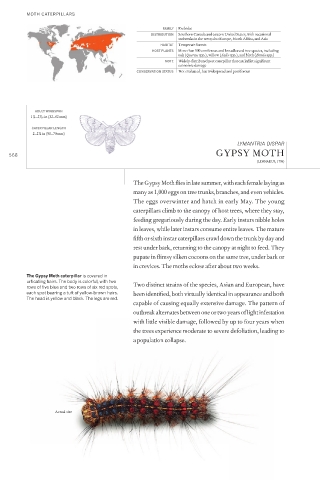
          The Gypsy Moth caterpillar is covered in
          urticating hairs. The body is colorful, with two   Two distinct strains of the species, Asian and European, have
          rows of   ve blue and two rows of six red spots,

          each spot bearing a tuft of yellow-brown hairs.   been identi ed, both virtually identical in appearance and both
          The head is yellow and black. The legs are red.
                                            capable of causing equally extensive damage. The pattern of
                                            outbreak alternates between one or two years of light infestation
                                            with little visible damage, followed by up to four years when
                                            the trees experience moderate to severe defoliation, leading to
                                            a population collapse.


                   Actual size

