


Page 568 - The Book of Caterpillars: A Life-Size Guide to Six Hundred Species From Around the World
P. 568
MOTH CATERPILLARS

                                                     FAMILY  Erebidae
                                                 DISTRIBUTION  Eastern North America
                                                    HABITAT  Forests and parks
                                                  HOST PLANTS  Various, in particular hickory (Carya spp.) and walnut
                                                          (Juglans spp.)
                                                      NOTE  Caterpillar that is protected by a covering of irritating hairs
                                             CONSERVATION STATUS  Not evaluated, but common within its range


            ADULT WINGSPAN
           1 ⁄  –2⅛ in (37–55 mm)
           CATERPILLAR LENGTH
           1 ⁄  –1¾ in (40–45 mm)
                                                                          LOPHOCAMPA CARYAE
                                                 HICKORY TUSSOCK MOTH
    566
                                                                                     HARRIS, 1841


                                            Hickory Tussock Moth caterpillars hatch from eggs laid in
                                            clusters on leaves of the food plant. The young larvae are
                                            gregarious, staying together in large groups, skeletonizing
                                            leaves, although as they get older they disperse and lead solitary
                                            lives. The caterpillars crawl to the ground to pupate in late
                                            summer and fall, spinning a loose cocoon in the leaf litter, where
                                            they overwinter. The adult moths are on the wing during early
                                            summer, with a single generation a year.


                                            Unlike the hairs of some of its relatives, the hairs of this
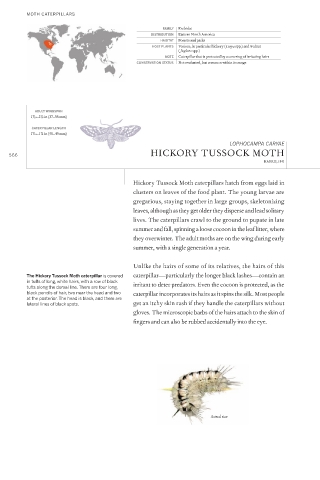
          The Hickory Tussock Moth caterpillar is covered   caterpillar—particularly the longer black lashes—contain an
          in tufts of long, white hairs, with a row of black   irritant to deter predators. Even the cocoon is protected, as the
          tufts along the dorsal line. There are four long,
          black pencils of hair, two near the head and two   caterpillar incorporates its hairs as it spins the silk. Most people
          at the posterior. The head is black, and there are
          lateral lines of black spots.     get an itchy skin rash if they handle the caterpillars without
                                            gloves. The microscopic barbs of the hairs attach to the skin of

                                             ngers and can also be rubbed accidentally into the eye.


                                                                    Actual size

