


Page 567 - The Book of Caterpillars: A Life-Size Guide to Six Hundred Species From Around the World
P. 567
MOTH CATERPILLARS

                      FAMILY  Erebidae
                  DISTRIBUTION  Colombia, Ecuador, Bolivia, and likely Peru
                     HABITAT  Humid montane forest borders, pastures, and river edges
                  HOST PLANTS  Many, most commonly Boehmeria bullata, B. caudate, B. pavoni,
                           and B. ulmifolia; also species of several other families, including
                           Poaceae and Fabaceae
                      NOTE  Uniquely shaped caterpillar that is highly polyphagous
             CONSERVATION STATUS  Not evaluated, but not considered threatened


                                                                                   ADULT WINGSPAN
                                                                                  1¾–2 ⁄   in (44–52 mm)
                                                                                  CATERPILLAR LENGTH
                                                                                  2 ⁄  –2 ⁄   in (52–58 mm)
            LOPHOCAMPA ATRICEPS
            LOPHOCAMPA ATRICEPS                                                                  565

            (HAMPSON, 1901)


            Lophocampa atriceps caterpillars feed in groups until the third
            instar, moving to separate leaves or plants to feed solitarily in
            later instars. Although the highly polyphagous caterpillar has
            been reared a number of times and has an extensive geographical
            distribution, its complete life cycle has not been described,
            and little is known of its natural enemies. Like other species in
            its cloud forest habitat, however, it likely has many parasitoid
            and other enemies. When disturbed, the larvae raise their
            posterior-most abdominal segments and wiggle them back
            and forth like a dog’s tail, perhaps brandishing this tuft of hairs
            to potential predators.


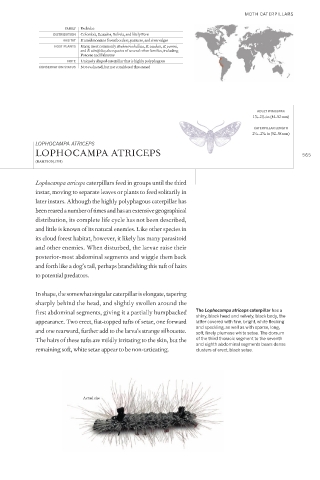
            In shape, the somewhat singular caterpillar is elongate, tapering
            sharply behind the head, and slightly swollen around the
            first abdominal segments, giving it a partially humpbacked   The Lophocampa atriceps caterpillar has a
                                                                shiny, black head and velvety, black body, the
            appearance. Two erect,  at-topped tufts of setae, one forward   latter covered with   ne, bright, white   ecking

            and one rearward, further add to the larva’s strange silhouette.   and speckling, as well as with sparse, long,
                                                                soft,   nely plumose white setae. The dorsum
            The hairs of these tufts are mildly irritating to the skin, but the   of the third thoracic segment to the seventh
            remaining soft, white setae appear to be non-urticating.    and eighth abdominal segments bears dense
                                                                clusters of erect, black setae.


                            Actual size

