


Page 571 - The Book of Caterpillars: A Life-Size Guide to Six Hundred Species From Around the World
P. 571
MOTH CATERPILLARS

                      FAMILY  Erebidae
                  DISTRIBUTION  Eastern Ecuador, most of eastern Peru
                     HABITAT  Montane cloud forest borders and nearby second-growth habitats
                  HOST PLANTS  Erato polymnioides and Miconia spp.
                      NOTE  Caterpillar patterned in orange, red, and brown, like the adult
             CONSERVATION STATUS  Not evaluated, but not considered threatened


                                                                                   ADULT WINGSPAN
                                                                                  1⅝–1⅞ in (42–48 mm)
                                                                                  CATERPILLAR LENGTH
                                                                                  2⅛–2¾ in (55–70 mm)
            MELESE PERUVIANA
            MELESE PERUVIANA                                                                     569

            (ROTHSCHILD, 1909)


            Melese peruviana caterpillars are found feeding as solitary
            individuals, resting on the top of their host plant leaves. When
            disturbed, they generally lift their thorax from the leaf surface,
            wiggle it about a little halfheartedly, and then drop from the
            plant to crawl quickly out of sight into the leaf litter. In their  nal

            instar, they are large, attractive caterpillars, with fewer setae than
            many members of the Erebidae. The long, quite tightly packed
            tufts of setae that project forward over the head appear almost
            like the antennae of an adult insect and are perhaps used to sense
            air currents produced by the approach of a potential predator.
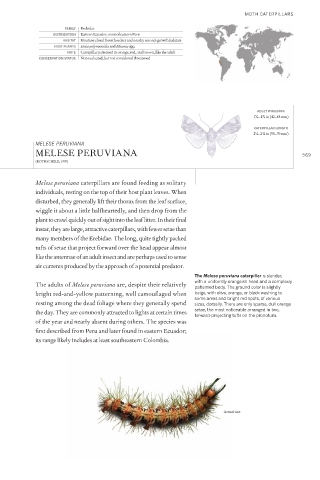
                                                               The Melese peruviana caterpillar is slender,
            The adults of Melese peruviana are, despite their relatively   with a uniformly orangeish head and a complexly
                                                               patterned body. The ground color is slightly
            bright red-and-yellow patterning, well camouflaged when   beige, with olive, orange, or black washing to
            resting among the dead foliage where they generally spend   some areas and bright red spots, of various
                                                               sizes, dorsally. There are only sparse, dull orange
            the day. They are commonly attracted to lights at certain times   setae, the most noticeable arranged in two,
                                                               forward-projecting tufts on the pronotum.
            of the year and nearly absent during others. The species was
             rst described from Peru and later found in eastern Ecuador;

            its range likely includes at least southeastern Colombia.


                                                                        Actual size

