


Page 569 - The Book of Caterpillars: A Life-Size Guide to Six Hundred Species From Around the World
P. 569
MOTH CATERPILLARS

                      FAMILY  Erebidae
                  DISTRIBUTION  Canada, eastern and western United States
                     HABITAT  Deciduous and mixed forest
                  HOST PLANTS  Various, but mostly poplar (Populus spp.) and willow (Salix spp.)
                      NOTE  Brightly colored caterpillar whose hairs can cause an
                           allergic reaction
             CONSERVATION STATUS  Not evaluated


                                                                                   ADULT WINGSPAN

                                                                                  1⅜–1¾ in (35–45 mm)

                                                                                  CATERPILLAR LENGTH
                                                                                    2 in (50 mm)
            LOPHOCAMPA MACULATA
            SPOTTED TUSSOCK MOTH                                                                 567

            HARRIS, 1841


            Spotted Tussock Moth caterpillars hatch from eggs laid on
            the leaves of the host plant and become active in summer and
            early fall, feeding on leaves of a range of deciduous food plants.
            The mature larvae move to the ground to pupate in loose
            cocoons formed from silk and hairs. They overwinter, and the
            night- ying adults emerge in early summer. There is a single

            generation a year.

            The eye-catching colors of the Lophocampa maculata caterpillar,
            which are variable in di erent parts of its range, are a warning to

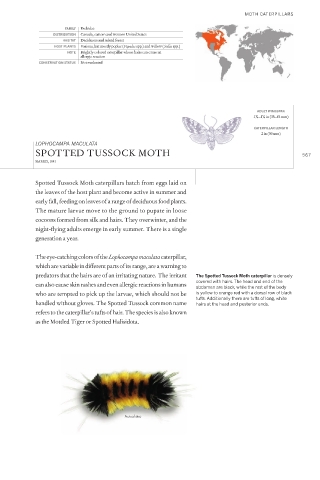
            predators that the hairs are of an irritating nature. The irritant   The Spotted Tussock Moth caterpillar is densely
            can also cause skin rashes and even allergic reactions in humans   covered with hairs. The head and end of the
                                                                abdomen are black, while the rest of the body
            who are tempted to pick up the larvae, which should not be   is yellow to orange red with a dorsal row of black
            handled without gloves. The Spotted Tussock common name   tufts. Additionally there are tufts of long, white
                                                                hairs at the head and posterior ends.
            refers to the caterpillar’s tufts of hair. The species is also known
            as the Mottled Tiger or Spotted Halisidota.


                                         Actual size

