


Page 572 - The Book of Caterpillars: A Life-Size Guide to Six Hundred Species From Around the World
P. 572
MOTH CATERPILLARS

                                                     FAMILY  Erebidae
                                                 DISTRIBUTION  From eastern Canada and eastern United States to the Caribbean,
                                                          south to central Argentina
                                                    HABITAT  Fields, grasslands, gardens, and open areas
                                                  HOST PLANTS  Various grasses, including crops such as Oat (Avena sativa),
                                                          Pearl Millet (Pennisetum glaucum), Sugarcane (Saccharum
                                                          o   cinarum), Sorghum (Sorghum bicolor), Wheat (Triticum
                                                          aestivum), and Maize (Zea mays)
                                                      NOTE  Striped caterpillar that feeds on grasses
                                             CONSERVATION STATUS  Not evaluated, but common


            ADULT WINGSPAN
          1 ⁄  –1  ⁄   in (33–43 mm)
           CATERPILLAR LENGTH
           2–2⅜ in (50–60 mm)
                                                                                MOCIS LATIPES
                                                    STRIPED GRASS LOOPER
    570
                                                                                    (GUENÉE, 1852)


                                            Striped Grass Looper caterpillars hatch from eggs laid on grass
                                            blades; a single female will lay more than 250. Young larvae
                                            usually just scrape the top surface of the leaf, while the later
                                            instars feed on entire leaves. To avoid predators and parasitoids,
                                            they feed at night and spend the day in a shelter at the base of the
                                            leaf. When disturbed, the caterpillars drop to the ground, where
                                            they blend perfectly with the dry stems and leaves of their host
                                            plants. Development over seven instars takes about 27 days at
                                            temperatures of around 68°F (20°C). The larvae pupate inside
                                            a grass shelter.


                                            Mocis latipes adults  y from May through December in northern
                                            locales but can breed continuously in the tropics. The caterpillar
                                            can be a damaging pest of pasture grasses, sorghum, maize, and
                                            rice, with occasional outbreaks on sugarcane in tropical areas
                                            such as the Caribbean. It is controlled by parasitoids such as
                                            sarcophagid flies, and braconid, chalcid, and ichneumonid
                                            wasps. Mocis latipes represents a large genus of about 40 species,
                                            many of which are similar-looking.


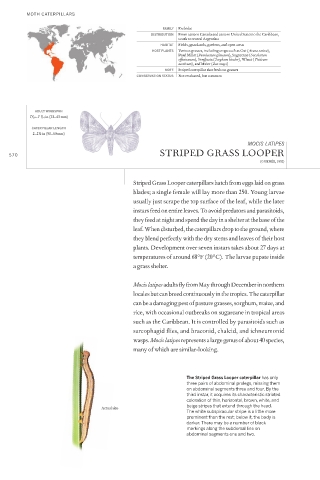
                                                             The Striped Grass Looper caterpillar has only
                                                             three pairs of abdominal prolegs, missing them
                                                             on abdominal segments three and four. By the
                                                             third instar, it acquires its characteristic striated
                                                             coloration of thin, horizontal, brown, white, and
                                 Actual size                 beige stripes that extend through the head.
                                                             The white subspiracular stripe is a little more
                                                             prominent than the rest; below it, the body is
                                                             darker. There may be a number of black
                                                             markings along the subdorsal line on
                                                             abdominal segments one and two.

