


Page 573 - The Book of Caterpillars: A Life-Size Guide to Six Hundred Species From Around the World
P. 573
MOTH CATERPILLARS

                      FAMILY  Erebidae
                  DISTRIBUTION  The Andes of Colombia, Ecuador, and Peru
                     HABITAT  Primary and secondary cloud forests, especially along streams
                           and other areas of disturbance
                  HOST PLANTS  Various, including Columnea ericae, Chusquea scandens,
                           Rubus spp., Miconia spp., and Tibouchina lepiota


                      NOTE  Caterpillar that is di cult to see despite its contrasting coloration
             CONSERVATION STATUS  Not evaluated, but not considered threatened


                                                                                   ADULT WINGSPAN
                                                                                  1½–1¾ in (38–44 mm)
                                                                                  CATERPILLAR LENGTH
                                                                                  1⅜–1 ⁄   in (35–40 mm)


            NEONERITA HAEMASTICTA
            NEONERITA HAEMASTICTA                                                                571
            DOGNIN, 1906


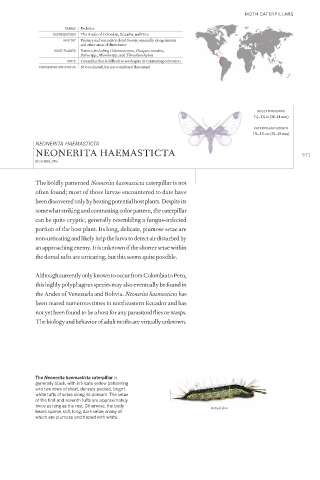
            The boldly patterned Neonerita haemasticta caterpillar is not
            often found; most of those larvae encountered to date have
            been discovered only by beating potential host plants. Despite its
            somewhat striking and contrasting color pattern, the caterpillar
            can be quite cryptic, generally resembling a fungus-infected
            portion of the host plant. Its long, delicate, plumose setae are
            non-urticating and likely help the larva to detect air disturbed by
            an approaching enemy. It is unknown if the shorter setae within
            the dorsal tufts are urticating, but this seems quite possible.


            Although currently only known to occur from Colombia to Peru,
            this highly polyphagous species may also eventually be found in
            the Andes of Venezuela and Bolivia. Neonerita haemasticta has
            been reared numerous times in northeastern Ecuador and has

            not yet been found to be a host for any parasitoid  ies or wasps.
            The biology and behavior of adult moths are virtually unknown.


            The Neonerita haemasticta caterpillar is
            generally black, with intricate yellow patterning
            and two rows of short, densely packed, bright
            white tufts of setae along its dorsum. The setae
            of the   rst and seventh tufts are approximately
            twice as long as the rest. Otherwise, the body          Actual size
            bears sparse, soft, long, dark setae, many of
            which are plumose and tipped with white.

